
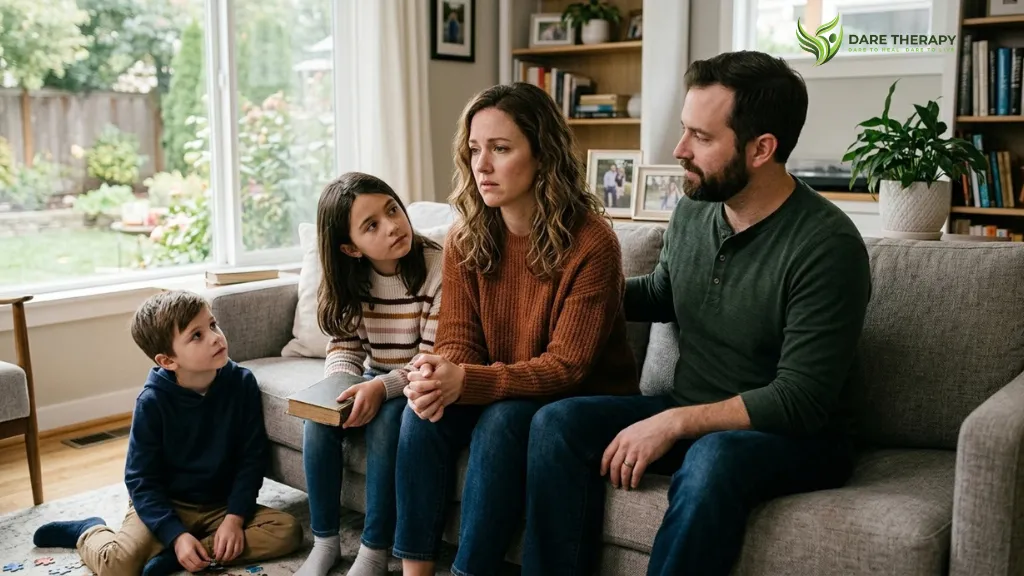
Anxiety rarely stays contained to one person.
A partner starts managing conversations more carefully to avoid setting off a spiral. Kids pick up on tension they can’t name but definitely feel. A whole household schedule can quietly reorganize itself around one person’s anxious patterns, plans canceled at the last minute, decisions that take three times longer than they should, a low hum of walking on eggshells nobody talks about directly. Understanding how that spread actually happens, and when it’s worth bringing the whole family into treatment instead of just the person carrying the diagnosis, changes what recovery actually looks like.
How anxiety ends up touching everyone in the house
Mostly through accommodation, which sounds supportive and often backfires anyway. This is part of why anxiety that seems to come out of nowhere can be so disorienting for a whole family, not just the person experiencing it, since nobody around them has a clear trigger to point to either.
A partner starts answering questions the anxious person is too overwhelmed to answer themselves. A parent starts making phone calls the anxious person can’t bring themselves to make. Kids learn which topics are safe to raise without anyone ever explaining why. All of it comes from a good place, wanting to ease someone’s suffering. It also quietly reinforces the anxiety, since it removes the person’s chances to actually face what’s triggering it. The family ends up organized around managing symptoms instead of around ordinary daily life, and that shift usually happens so gradually nobody notices until it’s fully in place.
What accommodation actually looks like day to day
Specific things, usually. Reassurance seeking is common, the same worry asked out loud repeatedly, family members answering it every time instead of ever setting a limit. Overthinking and anxiety often feed that pattern directly, since a family that keeps answering the same spiraling question doesn’t actually interrupt the spiral, it just moves it along a step. Avoidance gets absorbed too. A spouse takes over tasks that make the anxious partner anxious. A parent makes excuses to teachers or coaches instead of letting their child work through something hard directly. Household routines often shift around triggers, certain restaurants, certain drives, certain events avoided entirely, not because anyone decided that as a family, but because it became the path of least resistance one small choice at a time. A family gathering someone with social anxiety dreads, or a party that always brings on anxiety before it even starts, tends to get quietly worked around rather than worked through, and everyone ends up adjusting without ever naming why.
None of this makes anyone wrong for doing it. It’s an understandable response to watching someone you love struggle. It just tends to make the anxiety more entrenched, not less.
Do young kids actually pick up on a parent’s anxiety
Earlier and more accurately than most parents expect. Children read tension and mood shifts long before they have words for what they’re noticing.
A child raised by a highly anxious parent often absorbs some of that anxious view of the world, not through anything explicit being said, but through watching. If a parent treats ordinary situations as dangerous, a minor illness, a normal social interaction, a routine change in plans, kids tend to pick up that same threat calculation even when nobody ever tells them the world is dangerous outright. This isn’t destiny. Plenty of kids raised by anxious parents never develop anxiety disorders themselves. But it’s a real, well documented risk factor, and it’s part of why treating a parent’s anxiety often ripples well past the person actually in treatment.
Can a partner’s anxiety wear down a relationship over time
It can, largely through the same accommodation pattern, just playing out between two adults instead of a parent and child.
A non anxious partner often ends up carrying more emotional labor, managing logistics, softening bad news, running interference with other people, to keep the household calm. Over years that imbalance tends to build resentment, even when both people care about each other and nobody’s being intentionally unfair. The anxious partner, meanwhile, can end up feeling infantilized or unsure of their own judgment, since so much has quietly been taken off their plate. Neither person set out to build that dynamic. It usually accumulates through thousands of small, reasonable seeming decisions made under stress, none of which felt like a big deal at the time.
Knowing when to bring family into treatment, not just the individual
A few signals tend to point that direction pretty clearly. Accommodation patterns so ingrained that family members genuinely don’t know how to respond differently, even when they want to. The anxious person’s individual treatment progressing while home dynamics stay exactly the same, symptoms easing while the household is still organized around the old pattern. Other family members showing their own strain, exhaustion, resentment, anxiety absorbed from years of constant accommodation. And family members directly asking for guidance instead of continuing to guess.
That last one comes up more than people expect. A lot of family members genuinely want to help and simply don’t know what that looks like, since instinct usually points straight toward comfort and accommodation, the exact thing that tends to keep anxiety entrenched in the first place.
What family therapy for anxiety actually involves
Not assigning blame. Not treating family members as the cause of someone’s anxiety. It’s about giving everyone in the household a shared, accurate understanding of how anxiety actually works, plus specific tools for responding in ways that support recovery instead of unintentionally reinforcing symptoms.
Usually that starts with education, what anxiety is, why reassurance seeking and avoidance make things worse over time even though they feel helpful in the moment. Then it moves into practical skill building. How to respond supportively without over accommodating. How to encourage someone to face a feared situation instead of rescuing them from it. How family members can manage their own anxiety about the anxious person’s anxiety, which is its own real pattern worth naming out loud. For families with kids, this often includes age appropriate ways to talk about anxiety honestly without scaring a child or handing them a caretaker role that was never theirs to carry.
Isn’t it simpler to just treat the diagnosed person and leave it there
Sometimes individual treatment alone is genuinely enough, particularly for milder anxiety where family patterns haven’t become deeply set yet. This is often the actual question underneath does my anxiety need therapy or will it go away on its own, and the family piece is exactly what that question tends to leave out. But for anxiety that’s been around for years, or severe enough that daily family functioning has reorganized around it, treating only the individual while leaving accommodation untouched at home tends to limit how much progress actually sticks.
Someone can make real gains individually, learn to sit with discomfort instead of avoiding it, challenge anxious thoughts, build new coping tools, and then go home to a family system still set up to reinforce the old pattern. A partner who’s spent years making the anxious person’s phone calls doesn’t automatically stop just because therapy is going well. That gap between individual progress and unchanged home dynamics is exactly where family involvement tends to matter most.
What if the anxious family member doesn’t want others involved
Reasonable concern, and it doesn’t require sharing private clinical details with family to get real value out of it. Family sessions can stay focused on general anxiety education and household dynamics without ever touching what’s covered in someone’s individual sessions.
A lot of the most useful family work, learning what accommodation actually looks like, how to respond differently, how to support without rescuing, doesn’t require confidentiality to be broken at all. It’s about changing patterns in the home, which is its own intervention regardless of what does or doesn’t get shared from anyone’s individual treatment.
Couples therapy versus family therapy with kids
The core mechanism is the same, accommodation, absorbed emotional labor, avoidance reinforced by good intentions, but the day to day texture looks a little different between two adults than between a parent and a child.
With a couple, the work often centers on renegotiating who carries what, since years of accommodation tend to build lopsided responsibility that both people have simply gotten used to without noticing. It also frequently involves the non anxious partner learning to sit with their own discomfort once they stop immediately rescuing, since watching someone you love sit with anxiety instead of stepping in can feel genuinely hard, even once you understand intellectually why it matters.
How long it actually takes for family patterns to shift
Longer than most families expect walking in, mostly because unlearning years of accommodation takes real, repeated practice, not one conversation about doing things differently.
Early sessions usually focus on naming the specific accommodation patterns at play, since a lot of families are doing this so automatically they can’t identify it without help pointing it out. Once patterns are named, change tends to happen gradually, a few situations at a time rather than everywhere at once. Families who stick with it often notice smaller shifts within a handful of sessions, a reassurance seeking question that goes unanswered without anyone feeling terrible about it, a task handed back to whoever used to avoid it, well before the bigger patterns fully resolve.
What actually changes once a family works on this together
Usually a fairly specific shift. Family members stop reflexively accommodating and start responding in ways that support the anxious person’s own coping skills instead of quietly replacing them.
That might mean a partner sitting with their own discomfort instead of immediately answering a reassurance seeking question. It might mean a parent letting a child work through an uncomfortable social situation instead of stepping in to fix it. None of this happens overnight, and it usually feels harder before it feels easier, since breaking an established pattern almost always does. Families who work through this together tend to describe a real shift though, not just in the anxious person’s symptoms, but in how the whole household actually runs day to day.
Does this look different for a first time anxious episode versus anxiety that’s been around for years
Somewhat. A household adjusting to anxiety tied to a recent life transition, a job change, a health scare, a new baby, is usually still flexible. Accommodation hasn’t hardened into a fixed routine yet, which means it tends to be easier to catch and redirect early, before everyone’s settled into roles around it without really deciding to.
A household that’s lived with someone’s anxiety for a decade or more has usually built entire systems around it that nobody remembers building on purpose. Who makes which calls. Who sits where at family gatherings to manage a specific trigger. Which topics never come up at dinner. Untangling that takes longer, not because the anxiety itself is necessarily worse, but because the surrounding structure has had years to calcify into something that just feels like “how this family works.”
What This Looks Like at Dare Therapy
Family therapy at Dare Therapy focuses on exactly this kind of pattern, giving every member of a household a shared understanding of how anxiety actually works and specific tools for responding differently, not assigning blame for how things got to where they are. Anxiety treatment for the individual family member continues alongside that work rather than instead of it, and online anxiety therapy in Boston makes both tracks accessible without adding another logistical burden to a household that’s often already stretched thin.
Disclaimer: This content is for general informational and educational purposes only and should not be considered professional medical advice. Always consult a qualified healthcare professional for advice regarding your individual health or treatment.
FAQs
Mostly through accommodation, family members answering reassurance seeking questions, taking over avoided tasks, and reorganizing routines around anxiety triggers, which unintentionally reinforces the anxiety over time.
Yes. Children pick up on tension early and can internalize an anxious framing of the world through modeling, even without anything explicit being said, though this isn't inevitable for every child.
When accommodation patterns are deeply ingrained, when individual progress hasn't shifted home dynamics, when other family members show signs of their own strain, or when family members are asking for real guidance.
No. Family sessions can focus on general anxiety education and changing household patterns without disclosing specifics from anyone's individual treatment.
No. Milder anxiety without deeply entrenched family patterns often responds well to individual treatment alone. Family involvement tends to matter most when anxiety has been present a long time or has reshaped daily household functioning.