The Gottman Method is a couples therapy approach built on more than 40 years of research into what actually happens inside relationships that last versus relationships that don’t. Developed by Dr. John Gottman and Dr. Julie Schwartz Gottman, it identifies specific, observable patterns in how couples fight, how they repair, how they talk to each other on an ordinary Tuesday and turns those patterns into a structured set of skills couples can practice in therapy. It’s one of the most widely taught couples therapy models in the country, and if you’ve ever heard a therapist mention “the Four Horsemen” or “turning towards,” that’s where it comes from.
That’s the short version. If you’re trying to decide whether this approach is worth pursuing for yourselves, or just because you keep seeing the term come up while researching couples therapy, here’s what’s actually behind it, what a session looks like, and where it does and doesn’t fit.
The Gottman Method is a couples therapy approach built on more than 40 years of research into what actually happens inside relationships that last versus relationships that don’t. Developed by Dr. John Gottman and Dr. Julie Schwartz Gottman, it identifies specific, observable patterns in how couples fight, how they repair, how they talk to each other on an ordinary Tuesday and turns those patterns into a structured set of skills couples can practice in therapy. It’s one of the most widely taught couples therapy models in the country, and if you’ve ever heard a therapist mention “the Four Horsemen” or “turning towards,” that’s where it comes from.
That’s the short version. If you’re trying to decide whether this approach is worth pursuing for yourselves, or just because you keep seeing the term come up while researching couples therapy, here’s what’s actually behind it, what a session looks like, and where it does and doesn’t fit.
What Is the Gottman Method, Really?
At its core, the Gottman Method treats a relationship less like a mystery and more like something you can actually study. Instead of leaning on a therapist’s gut feeling about what’s “really going on” between two people, it works from patterns that were observed, recorded, and tracked across thousands of real couples over decades.
In practice, that means therapy looks a little different than what a lot of people picture when they think of couples counseling. There’s less “so, tell me how you’re feeling this week” and more structured work: assessments that map exactly where the relationship is solid and where it’s shaky, guided exercises built around a real disagreement the couple is currently having, and specific communication skills that get practiced in the room, not just talked about.
If you’ve ever left a therapy session feeling like you understood the problem better but still had no idea what to actually do differently on Tuesday night when the same argument starts up again that’s usually the gap the Gottman Method is trying to close.
Where This Approach Actually Came From
It’s worth knowing that the Gottman Method isn’t a theory someone dreamed up and started teaching. It came out of watching people.
John Gottman started this work in the 1970s. He wasn’t originally a therapist by training his early background was in math and clinical psychology and that mathematical streak shows up in how methodically the research was built. Rather than asking couples to self-report on their relationships (which, as anyone who’s ever fought with a partner and then described the fight to a friend knows, isn’t always accurate), his team wanted to watch what actually happened.
So in 1986, they built what’s now famously known as the “Love Lab” at the University of Washington a small apartment-style space where couples would spend time together while researchers recorded everything: what they said, how they said it, their heart rates, even how their bodies reacted during a hard conversation. Couples would come in, get into a real disagreement about something they actually disagreed about, and the team would study the footage down to the second. Over years, this built into one of the largest datasets in relationship science.
Ten years later, in 1996, John Gottman and his wife, clinical psychologist Julie Schwartz Gottman, founded the Gottman Institute specifically to turn all that research into something therapists could use in an actual therapy room. That’s the “method” part: it’s the clinical translation of the research, built by two people who were married to each other and, by most accounts, applied a fair amount of it to their own relationship along the way.
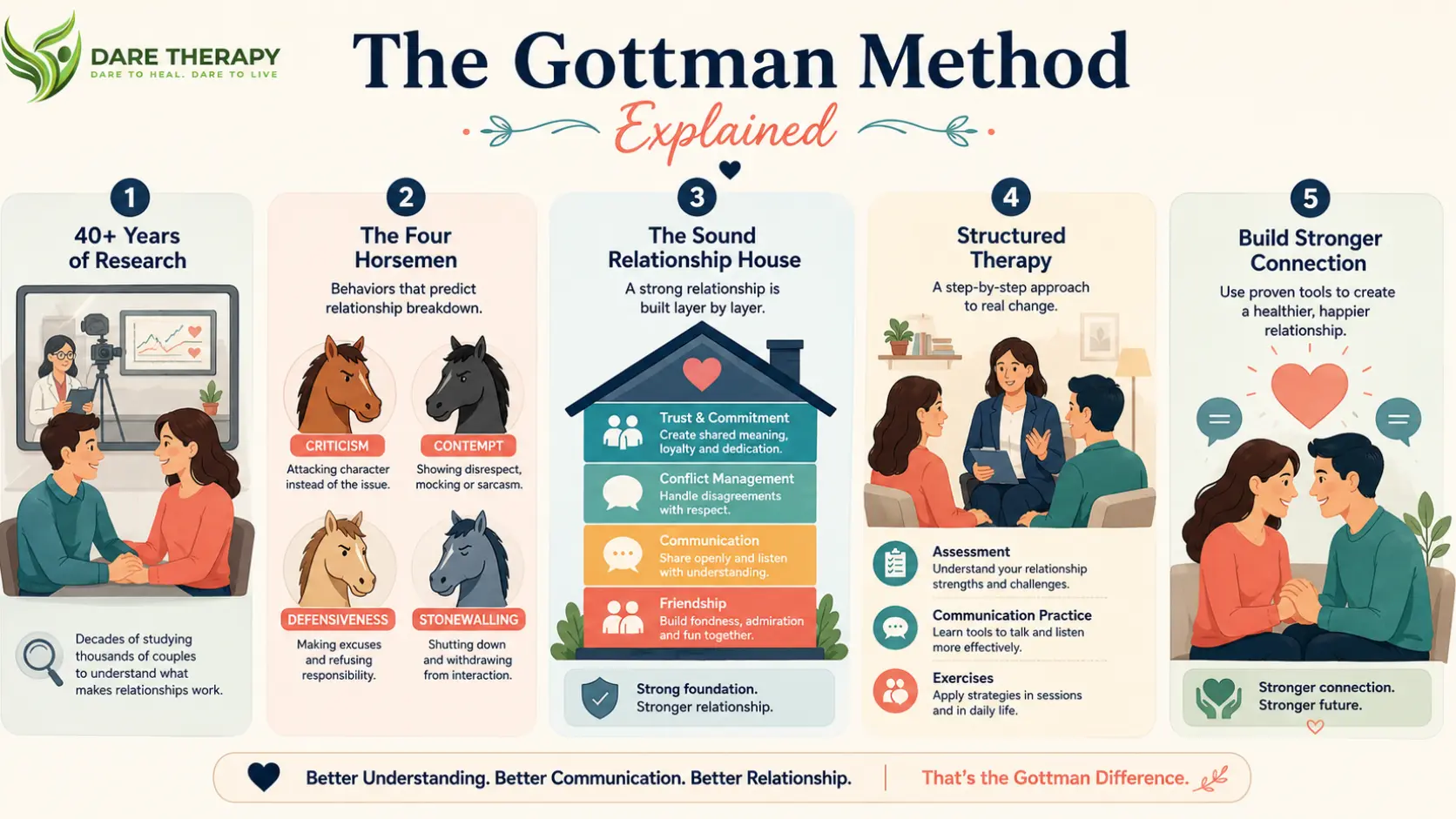
Two ideas from that research ended up becoming the backbone of the entire approach: the Four Horsemen and the Sound Relationship House.
The Four Horsemen: The Habits That Quietly Wreck Relationships
Somewhere in all those hours of recorded arguments, Gottman’s team started noticing the same four behaviors showing up again and again in couples whose relationships were struggling. He borrowed a biblical name for them the Four Horsemen mostly because, in his research, they really did tend to show up as warning signs of something bigger falling apart.
Horseman | What it sounds like | The antidote |
Criticism | Attacking a partner’s character instead of naming the actual issue “You never think about anyone but yourself” instead of “I was hurt you didn’t call to say you’d be late.” | A gentler, specific complaint that focuses on the behavior, not the person |
Contempt | Sarcasm, eye-rolling, mockery, or talking down to a partner communicating “I’m better than you,” not just “I disagree with you.” | Building a habit of noticing and expressing appreciation, even in small ways |
Defensiveness | Deflecting a complaint by blaming back, making excuses, or playing the victim instead of hearing what’s being said. | Taking some responsibility, even for a small part of the problem |
Stonewalling | Shutting down, going quiet, or physically withdrawing from a conversation because it feels like too much. | Taking a real break 20+ minutes, self-soothing then coming back to it |
Contempt is the one that gets singled out most often in Gottman’s writing, because in his research it was the single strongest predictor that a relationship was in real trouble more than the other three combined. It makes sense when you think about it: disagreeing with someone is very different from looking down on them.
None of this means you’re doomed if you recognize your own relationship in that table. Almost every couple slips into one of these at some point, especially when they’re tired, stressed, or fighting about something they’ve fought about fifty times before. The point of naming them isn’t to hand out blame, it’s that each one has a documented alternative, and a good chunk of Gottman Method therapy is simply helping a couple notice which horseman shows up for them and practice the antidote until it becomes the new default.
The Sound Relationship House: The Bigger Picture
The Four Horsemen get most of the attention because they’re catchy and easy to picture, but they’re really only about conflict. The framework that organizes the whole method including everything that has nothing to do with fighting is called the Sound Relationship House.
Picture an actual house, built level by level:
- Build love maps. This is the foundation of genuinely knowing your partner’s inner world. Their stresses, their history, what’s on their mind this week, who matters to them and why.
- Share fondness and admiration. Actively noticing and saying out loud what you respect or appreciate, instead of assuming your partner already knows.
- Turn towards instead of away. Responding to the small, easy-to-miss moments when a partner reaches out a comment, a sigh, a “hey, look at this” instead of letting them go unanswered. If this sounds familiar, it connects closely to what we’ve written about feeling emotionally distant from a partner a lot of that distance builds up from years of missed bids like these, not one big blowup.
- The positive perspective. Generally approach your partner assuming good intent, rather than starting from suspicion.
- Manage conflict. Not eliminating it Gottman’s research is actually pretty clear that conflict-free relationships aren’t realistic (more on that below) but learning to disagree in ways that don’t chip away at the relationship.
- Make life dreams come true. Actively supporting what your partner wants out of life, even the goals that don’t directly involve you.
- Create shared meaning. Building rituals, roles, and a sense of “us” the traditions and inside jokes and shared purpose that make a relationship feel like its own small culture.
Trust and commitment run up both sides of the house like walls, holding the whole structure together. In session, a Gottman-trained therapist is usually trying to figure out which floor of this house is shaky, sometimes it’s obvious (constant conflict), sometimes it’s quieter (a couple who never fights but has slowly stopped really knowing each other) and builds the treatment plan around reinforcing it.
What a Session Actually Looks Like
This is usually the part people are most curious about, so here’s the practical version.
Treatment typically opens with an assessment phase. This usually includes a joint interview, individual one-on-one time with each partner (so each person can speak candidly before the joint work starts), and standardized questionnaires that map the relationship against the Sound Relationship House. From there, the therapist holds a feedback session sharing what stood out in the assessment and proposing where to focus.
The actual working sessions tend to be hands-on. Rather than just discussing conflict in the abstract, couples often work through something they’re genuinely disagreeing about right now, in real time, with the therapist coaching them through it pointing out a horseman as it happens, or slowing things down to practice a repair attempt mid-argument. Homework between sessions is common too, usually short, specific exercises meant to build a new habit rather than one more thing to feel guilty about not finishing.
Compared to more open-ended talk therapy, it can feel closer to structured coaching in places. Some couples love that it gives them a concrete answer to “okay, but what do we actually do differently” instead of just more insight into what’s going wrong. Others prefer a looser, more exploratory style, which is worth being honest with a prospective therapist about before you start.
Why So Many Couples Therapists Use It
A few practical reasons this approach has become such a default in the field:
It’s built on watching real behavior, not just what people say about themselves. Because the underlying research came from observing actual couples rather than only asking them to describe their relationship, it captures patterns people often aren’t fully aware they’re doing.
It gives couples a shared vocabulary. When both partners know what “stonewalling” or “turning towards” means, it becomes possible to name what just happened in an argument without it turning into another argument about who’s right.
It doesn’t pretend conflict is the enemy. One of the more reassuring findings in Gottman’s research is that happy couples argue too. His team has estimated that roughly two-thirds of relationship conflicts are “perpetual” rooted in personality differences or fundamentally different needs that aren’t going to fully resolve, ever. The goal isn’t to win that argument once and for all. It’s learning to keep having it without it eroding the relationship.
It’s teachable. Because the model breaks the work into specific, describable skills and stages, it’s relatively easy to train therapists consistently which is a big part of why it’s spread as widely as it has.
Is It Right for Every Couple? Honestly, No.
A good therapist won’t oversell this, and neither should this article.
The famous claim you’ll see repeated everywhere online that Gottman’s team could predict divorce with over 90% accuracy comes from specific early studies, and it’s genuinely been questioned by other researchers, some of whom pointed to small sample sizes and methodology concerns. That doesn’t mean the underlying framework isn’t useful in a therapy room. It means the “90% accuracy” number is a research claim from certain studies, not a guarantee about what will happen to any particular couple, and it’s worth knowing that context exists rather than taking the headline stat at face value.
The approach also tends to work best for couples willing to engage in structured exercises and actually do the practice between sessions it’s less of a fit for people looking purely for open-ended, exploratory conversation with no homework attached. And like essentially every couples therapy model, it isn’t designed to be the first response to active abuse or safety concerns in a relationship. Those situations need a different kind of intervention, often individually, before couples work makes sense.
It’s also common for therapists not to use it in total isolation. Plenty blend it with other evidence-informed approaches most often Emotionally Focused Therapy (EFT) depending on what a specific couple needs more of.
Gottman Method vs. Other Couples Therapy Approaches
The comparison that comes up most is Gottman Method vs. EFT, since both are widely used and both are backed by research. Broadly: Gottman Method therapy tends to be more structured and skills-first, working directly on the communication patterns and conflict behaviors themselves. EFT tends to start a layer deeper, focusing on the underlying emotional bond and attachment needs that are usually driving those patterns in the first place.
Neither one is objectively “better.” In practice, a lot of therapists are trained in both and move between them depending on what’s actually happening in the room. The right fit usually has more to do with your specific relationship and your therapist’s training than with one method winning some kind of competition.
Can the Gottman Method Work in Online Therapy?
Yes and this is worth addressing directly, since more couples are choosing virtual sessions than ever. The assessments, the structured exercises, and the skill-building conversations all translate to video sessions without much loss. If anything, some couples find it easier to slow down and practice a difficult conversation from the comfort of their own living room than in an unfamiliar office. The one place virtual sessions require a little more intention is body language and timing cues a good therapist working online adjusts for that, checking in more explicitly rather than relying on picking up every physical cue in the room.
How to Find a Therapist Trained in This Method
Not every couples therapist has formal Gottman training, and levels of training vary. The Gottman Institute runs a tiered system Level 1, Level 2, and Level 3 training, plus a separate certification track that leads to the “Certified Gottman Therapist” credential. Plenty of therapists complete Level 1 or Level 2 and use Gottman tools and assessments regularly without pursuing full certification, so it’s a completely reasonable question to ask a prospective therapist directly: what level of Gottman training do you have, and how much of your work with couples actually draws on it?
Getting Started
If any of this sounds familiar the same argument on a loop, feeling unheard, or just noticing that you and your partner have drifted into more distance than closeness a Gottman-informed therapist can help name the specific patterns underneath it and start working on them directly, instead of circling the same conversation every few weeks. It also might be worth reading through the signs your relationship needs couples therapy if you’re still on the fence about whether now is the right time.
Dare Therapy’s virtual couples therapy for Boston and Massachusetts couples draws on the Gottman Method alongside other evidence-based approaches, matched to what your relationship actually needs not a one-size-fits-all script. And if you’re engaged rather than already in a strained spot, our premarital counseling sessions use a lot of these same tools proactively, before patterns like these get the chance to take hold. If you’re navigating a period of change together with a move, a new baby, a career shift our piece on emotional challenges during life transitions is a useful companion read, since transitions are exactly when the Sound Relationship House tends to get tested the most.
Disclaimer: This article is for general informational purposes only and does not replace professional mental health advice, diagnosis, or treatment. If you have concerns about your relationship or mental health, consider speaking with a qualified therapist.