

Feeling distant from your partner is one of the more common things people bring into a first therapy session, and one of the hardest to explain. Nothing dramatic has necessarily happened. There’s no affair, no blowup fight, sometimes not even an argument to point to. Just a sense that you and your partner aren’t quite reaching each other anymore, even living in the same house.
This feeling has a lot of possible sources, and it doesn’t automatically mean the relationship is in trouble. Sometimes it’s temporary and tied to a specific stretch of life. Sometimes it points to something that’s been building for a while and needs attention. This article walks through what emotional distance actually looks like, why it tends to happen, and what usually helps.
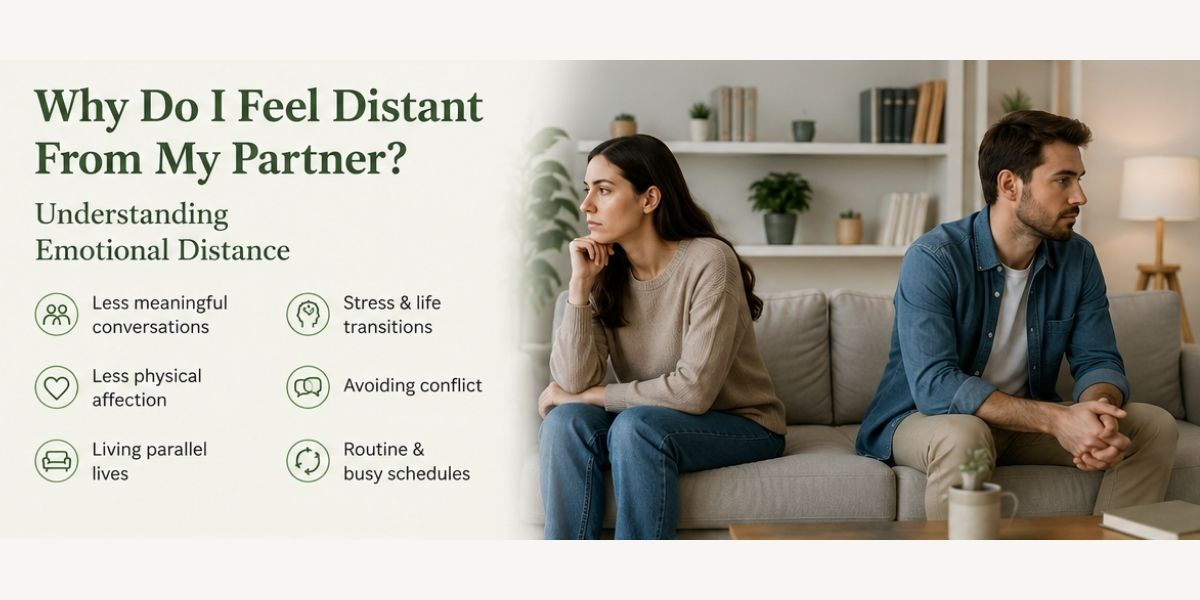
What Emotional Distance Actually Looks Like
People describe it differently, but a few patterns come up often. Conversations start to stay on logistics who’s picking up the kids, what’s for dinner, whether the bill got paid without much room for anything deeper. You might notice less physical affection, or affection that feels automatic rather than intentional. Evenings look more like two people occupying the same space than two people spending time together. You may find yourself not mentioning things that happened during your day, not because you’re hiding anything, but because it doesn’t occur to you that your partner would want to hear about it, or you’re not sure they’d really be listening.
None of these signs on their own means much. A busy week looks like this too. What people usually notice, when it’s more than a passing stretch, is that this pattern has settled in and stopped feeling temporary.
Common Reasons People Feel Distant From a Partner
There isn’t one cause. A few show up most often in therapy.
Stress and life transitions. A new baby, a demanding job, a move, a health scare, caring for aging parents — any of these can pull a couple’s attention away from each other for a while. This kind of distance is usually situational. It tends to ease once the pressure does, especially if both people notice it happening and stay a little intentional about reconnecting.
Avoiding conflict instead of working through it. Some couples don’t fight much at all, and it isn’t because everything’s fine — it’s because disagreements get swallowed instead of discussed. One partner learns to let things go to keep the peace. The other stops bringing things up because it never seems to lead anywhere. Over time, this can create real distance even though, from the outside, the relationship looks calm. The disagreements haven’t gone away. They’ve just stopped being said out loud.
Mismatched needs for closeness. People have different baseline needs for connection, and those needs can shift over time — with age, with stress, with how each person was raised to handle emotion. When one partner wants more closeness than the other is currently able to offer, it can feel like distance to one person and like normal life to the other.
Routine crowding out connection. Work, parenting, chores, and screens fill up most of the day. Couples can go weeks without a real conversation simply because nothing in the schedule makes space for one. This is often the least dramatic cause and one of the more common ones.
Individual mental health. Depression, anxiety, burnout, or grief can make someone feel emotionally flat or hard to reach, even toward people they love. If you’ve been feeling numb or checked out generally, not just in your relationship, it’s worth considering whether something else might be going on — distance in a relationship is sometimes a symptom of something happening in one partner individually, not a sign the relationship itself is failing. The same is true if anxiety has been building in the background; it’s worth asking whether it’s something that needs support or is likely to settle on its own.
Withdrawal as a way of coping. When conversations get tense, some people go quiet rather than engage — not out of indifference, but because it feels safer than risking another difficult exchange. This is a common, almost automatic response to conflict, sometimes called stonewalling. Used occasionally to cool down, it’s not a problem. Used as the default response, it tends to leave both partners feeling more alone.
Is Feeling Distant Always a Sign Something Is Wrong?
Not necessarily. Every long-term relationship moves through closer and more distant periods — that’s normal, not a red flag by itself. What matters more is whether the distance has an identifiable cause, whether it eases once that cause passes, and whether both partners can still talk about it when they try.
It’s worth paying closer attention when the distance has lasted for months without an obvious reason, when attempts to reconnect don’t go anywhere, or when one or both of you have started to feel more like housemates managing logistics than partners who know what’s going on with each other. None of that means the relationship is doomed. It usually just means the distance has become a pattern rather than a passing phase, and patterns tend to need more than time to shift.
What Can Help When You’re Feeling Distant From Your Partner
A few things tend to make a real difference, even before anyone sets foot in a therapist’s office.
Naming it out loud, gently, is often the hardest and most useful step. Something like “I’ve felt a little far from you lately, and I miss us” tends to land better than silence or, on the other end, a sudden confrontation. Small, regular moments of connection matter more than grand gestures — a real ten-minute conversation without phones, asking a genuine question about your partner’s day and actually listening to the answer, physical affection that isn’t just habit. Getting curious instead of assuming also helps: distance often gets interpreted as rejection when it’s really exhaustion, stress, or something the other person hasn’t found words for yet. And if there are specific things that have gone unsaid for a while, finding a low-pressure way to bring them up usually does more than waiting for the moment to feel right, which often doesn’t come on its own.
When Additional Support Might Help
If the distance has been going on for a while, if conversations about it keep stalling, or if one or both of you want to reconnect but aren’t sure how, working with a couples therapist can help. Therapy for this kind of concern isn’t about assigning blame or relitigating old arguments it’s usually about learning to notice each other again, understanding what’s driving the withdrawal on either side, and rebuilding habits of connection that have quietly fallen away. This isn’t the only path back to each other, but for a lot of couples it helps to have someone trained to guide that conversation.
Dare Therapy offers virtual couples therapy for people in the Boston area and across Massachusetts, and Dare Therapy also offers online medication management in Boston Massachusetts. if this is something you and your partner are considering.
Disclaimer: The information provided on this website is for general educational purposes only and is not a substitute for professional medical advice, diagnosis, or treatment. Always consult a qualified healthcare professional regarding any medical concerns or before making decisions about your health.