

Feeling emotionally numb instead of sad is one of the most common and least talked about experiences of depression. Numbness in depression happens because the brain’s emotional processing system becomes dysregulated under sustained psychological stress, flattening emotional responses across the board rather than producing the sadness most people associate with the condition. You do not feel sad. You do not feel much of anything. Things that used to matter stop mattering. People you love feel far away even when they are in the same room. And because it does not feel like what depression is supposed to feel like, many people conclude that what they are experiencing is not depression at all which delays getting support and deepens the isolation. This guide explains why emotional numbness happens in depression, why it is often more distressing than sadness, and what actually helps.
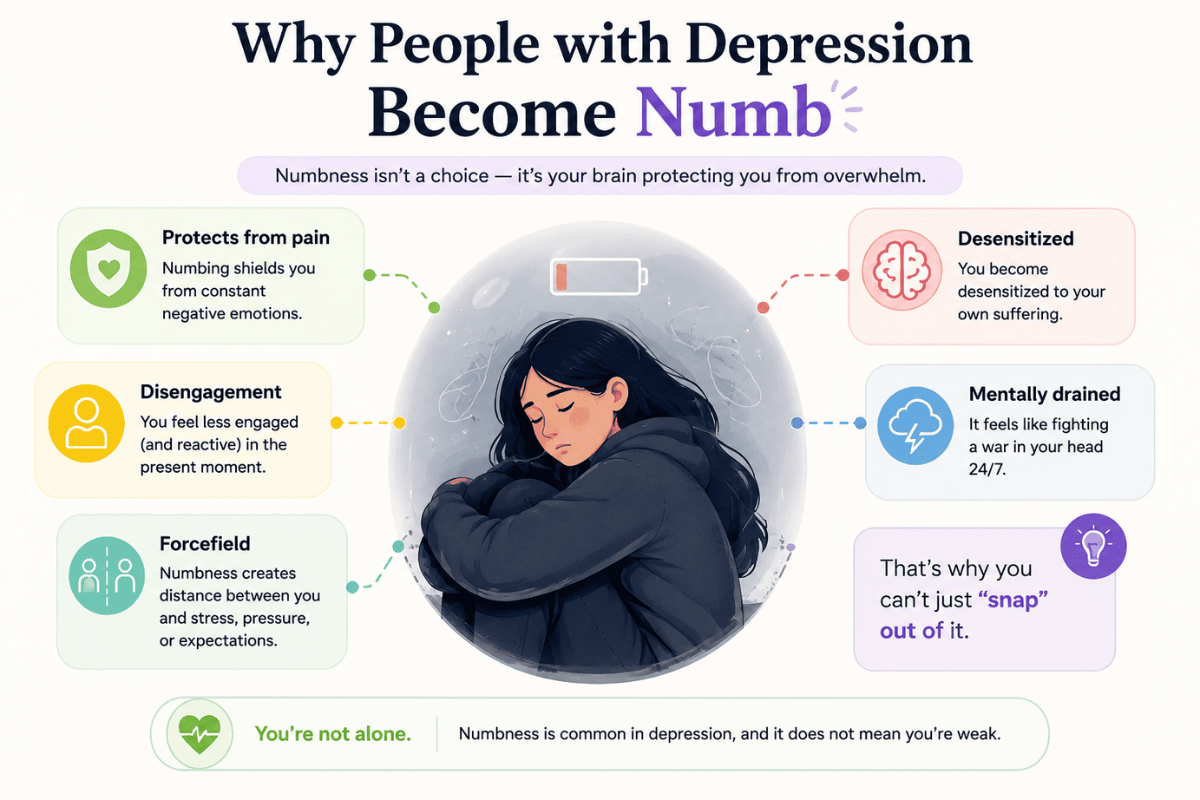
Why Numbness Does Not Feel Like Depression?
The cultural image of depression is sadness crying, withdrawn, visibly struggling. This is not wrong, but it is incomplete. For a significant number of people, depression presents not as intense sadness but as a flattening of all emotional experience. Not low mood no mood. Not pain-free.
This disconnect between expectation and experience is itself part of what makes emotional numbness so difficult. When you feel deeply sad, at least the emotion matches the diagnosis. When you feel nothing, the mismatch is confusing. People often describe it as watching their own life from behind glass present in the room but not connected to what is happening in it.
The confusion is compounded by how depression is talked about publicly. If you search for depression symptoms, sadness appears at the top of almost every list. Numbness appears further down, if at all. This leads people to minimise or misidentify what they are experiencing, concluding it must be stress, burnout, personality, or simply “the way I am” rather than recognising it as a symptom of a treatable condition.
What Is Happening in the Brain During Emotional Numbness?
Emotional numbness in depression is not an absence of brain activity, it is a specific pattern of dysregulation across the systems that generate and process emotional experience.
The prefrontal cortex and emotional regulation
The prefrontal cortex, the part of the brain responsible for emotional regulation, decision-making, and connecting present experience to meaning, shows reduced activity in depression. This reduction affects not just the processing of negative emotions but the experience of emotion more broadly. When the prefrontal cortex is underactive, the dampening effect applies across the emotional spectrum: positive emotions become inaccessible, negative emotions become flat, and the felt sense of caring about things what neuroscientists sometimes call emotional salience diminishes.
This is why emotional numbness in depression feels qualitatively different from sadness. Sadness is still a painful emotion, but present. Numbness is the loss of the feeling itself. The brain is not generating the emotional signal that the prefrontal cortex would normally process.
Anhedonia the loss of pleasure and meaning
The clinical term for the inability to experience pleasure is anhedonia, and it is one of the two core diagnostic criteria for major depressive disorder (alongside depressed mood). Anhedonia is a direct expression of emotional numbing the reward and motivation systems of the brain are underperforming, and things that previously produced enjoyment, interest, or a sense of meaning no longer do.
Anhedonia is not the same as not wanting to do things. It is doing things and feeling nothing. Watching a film you used to love and feeling no response. Being with people you care about and feeling no warmth. Finishing a task and feeling no satisfaction. The activity occurs; the emotional response that used to accompany it does not arrive.
This is one of the most disorienting aspects of depression. The person can see that their life contains things that should produce feeling, and they cannot understand why they feel nothing in response to them.
The role of chronic stress and cortisol
Sustained psychological stress keeps cortisol levels chronically elevated. Over time, this chronic elevation has direct effects on brain structures involved in emotional processing including the hippocampus, which is involved in contextualising emotional experience, and the amygdala, which is involved in generating emotional responses.
The brain’s response to chronic stress includes a degree of emotional blunting that functions, at a biological level, as a protective mechanism reducing the intensity of emotional experience when the system has been in a state of sustained activation for too long. What begins as an adaptive response to overwhelm becomes, in depression, a persistent state that no longer switches off even when the acute stressor has passed.
Antidepressant medication and emotional blunting
It is worth noting a specific context in which emotional numbness arises that is not always discussed openly: antidepressant medication. SSRIs and SNRIs are effective for depression in a significant proportion of people, but emotional blunting is a recognised side effect sometimes described as feeling better in the sense that the acute pain has reduced, but simultaneously feeling flat, less emotionally alive, or disconnected from positive experiences as well as negative ones.
If you are on antidepressant medication and experiencing emotional numbness, this is worth raising with your prescribing doctor or psychiatrist. Adjusting the dose, switching to a different medication, or adding a complementary approach often resolves or reduces the blunting. Numbness that emerges or worsens after starting medication is a different situation from numbness as a core symptom of depression and the two deserve different responses.
Our psychiatry and medication management service addresses exactly this kind of nuanced medication question including when to adjust, when to switch, and how medication and therapy work together rather than simply replacing each other.
Why Numbness Is Often More Distressing Than Sadness?
This surprises people who have not experienced it. Surely feeling nothing is easier than feeling pain? In practice, emotional numbness tends to produce its own particular form of suffering, one that is harder to articulate and therefore harder to seek support for.
The loss of connection
Emotional experience is the substrate of human connection. When you feel numb, relationships become difficult not because of conflict or distance, but because the emotional resonance that normally makes connection feel meaningful has gone quiet. You can be sitting with someone you love and feel nothing, not estrangement, not resentment, just absence.
This absence is often invisible to the people around you. You are present. You are functioning. You are not visibly distressed. And so no one asks if you are okay, because from the outside you appear to be. The invisibility of numbness is part of what makes it so isolating.
The absence of relief
With sadness, there are moments of relief, a good conversation, a crying release, a moment of distraction that provides temporary respite. Numbness does not work this way. There is no emotional peak to come down from, no release that provides relief. The flatness is continuous in a way that sadness typically is not.
People who have experienced both describe numbness as harder to tolerate precisely because of its featurelessness. Sadness, while painful, at least confirms that you are feeling something. Numbness raises a different and more unsettling question: am I capable of feeling anything at all?
The secondary despair it produces
The experience of feeling nothing particularly when you can remember feeling engaged, interested, loving, and alive often produces its own layer of despair. Not about a specific circumstance, but about the self. People describe wondering whether they are permanently changed, whether they will ever feel normal again, whether the numbness means something has been lost that cannot be recovered.
This secondary despair is not a realistic assessment of what is happening. Emotional numbness in depression is a symptom of a state the brain is in not a permanent alteration of who you are. It resolves as the depression resolves. But in the middle of the experience, when the numbness has been present long enough that it starts to feel like your baseline, that distinction is very hard to hold.
The Specific Things Numbness Affects
Emotional numbness in depression tends to show up in recognisable patterns. These are the areas people most frequently describe as affected:
Relationships: Feeling present but not connected. Going through the motions of caring without feeling the warmth behind it. Being unable to access the love you know you have for someone knowing it intellectually without feeling it.
Work and purpose: Tasks that once felt meaningful feel mechanical. The satisfaction that used to accompany doing good work does not arrive. Nothing feels important enough to justify the effort it requires.
Creativity and interests: Activities that previously absorbed and energised you reading, music, cooking, sport, anything that used to produce genuine enjoyment produce nothing. Attempting them can feel alienating rather than restorative.
The body: Emotional numbness frequently coexists with a kind of physical flatness food loses taste, sensory experiences lose their texture, the body feels distant or heavy. The felt sense of being in a living body with an appetite for experience has quieted.
Memory and self: Some people describe difficulty accessing memories of feeling happy, interested, or engaged not because the memories are absent, but because they have lost the emotional texture that made them feel real. The past feels remote. The future feels abstract and difficult to imagine.
Numbness as a Protective Response
One framework that some people find helpful and that has some clinical support is understanding emotional numbness as the psyche’s response to an emotional experience that was too much to process directly.
When pain, loss, disappointment, or sustained stress exceed the emotional system’s capacity to integrate them, numbness can function as a protective distance keeping the most distressing material at arm’s length while the system tries to find a way to process it. This is particularly common in the context of stress and trauma, where the emotional demands of an experience outpace the person’s resources for meeting them.
In this framing, numbness is not emptiness it is something held back, something the system is not yet equipped to let through. This does not mean the goal is to force emotional access. It means that as the conditions that made numbness necessary change through safety, support, and the right therapeutic approach emotional experience tends to return gradually rather than remaining absent permanently.
This is one of the reasons EMDR and trauma-informed therapy approaches are sometimes relevant in depression presentations that are heavily characterised by numbness and disconnection particularly where the numbness is rooted in past experiences that the system is still managing at a distance.
How Therapy Addresses Emotional Numbness?
Cognitive Behavioural Therapy (CBT)
CBT for depression addresses the thought patterns and behavioural withdrawal that sustain and deepen the numbness. Behavioural activation, the gradual, structured re-engagement with activities and relationships rather than waiting to feel motivated before acting is one of the most effective interventions for anhedonia specifically. The principle is that action precedes feeling in depression: waiting to feel ready before engaging keeps the numbness in place, while acting despite the numbness begins to gradually restore the emotional response that the depression has suppressed.
CBT also addresses the secondary layer of distress that numbness produces the catastrophic interpretations of what the numbness means (“I am broken,” “I can no longer feel,” “something is permanently wrong with me”) that deepen depression without reflecting reality.
Acceptance and Commitment Therapy (ACT)
ACT takes a different and often complementary approach. Rather than working to change the content of the experience, ACT works on the relationship with it specifically, the relationship with the fact of feeling nothing. The struggle against numbness, the distress about the distress, often amplifies and entrenches the experience. ACT provides tools for moving toward what matters in life even in the presence of emotional flatness which is both practically valuable and, over time, part of what begins to restore emotional engagement.
Individual therapy for depression
Individual therapy for depression regardless of specific modality provides something that is particularly valuable when emotional numbness is the presenting experience: a relationship in which feeling nothing is explicitly acceptable, where there is no expectation of emotional performance, and where the slow, patient work of restoring emotional access can happen at the pace the person’s system allows.
For people whose numbness is partly rooted in the experience of having to manage emotions rather than feel them a pattern often established early in life, in family systems where emotional expression was not safe or welcome this relational aspect of therapy is often where the most meaningful change occurs.
Couples therapy where numbness is affecting the relationship
Emotional numbness in one partner is one of the more difficult depression presentations for relationships to navigate. The person who is numb often cannot explain why they feel distant because the numbness itself is what prevents them from accessing the feeling of distance. The partner often experiences the withdrawal as rejection, criticism, or a sign that something is wrong with the relationship. Both are responding to the same thing the depression without either fully understanding that.
Couples therapy in the context of one partner’s depression is not about the relationship being the problem. It is about giving both people a space to understand what depression is doing to the connection, to reduce the secondary conflict that misinterpreted withdrawal produces, and to maintain the relationship as a source of support rather than an additional source of stress.
Numbness Is Not the End of Feeling
Whatever version of this experience you are having the absence of sadness that should be there, the flatness where engagement used to live, the sense of watching your own life from a distance it is not a verdict on who you are or what you are capable of feeling.
Emotional numbness is a symptom of a state the brain is in. It is recognisable, it is treatable, and it resolves. The fact that it does not look like what depression is supposed to look like does not make it less real or less worth taking seriously.
Dare Therapy offers individual therapy for depression including presentations that centre on emotional numbness, disconnection, and anhedonia rather than visible sadness via telehealth across Massachusetts. Our therapists use evidence-based approaches including CBT and ACT, matched to what you are specifically experiencing rather than a generic depression protocol.
If numbness is affecting your relationship as well as your own experience, couples therapy alongside individual work may be worth discussing. If medication is part of your picture or a question you are sitting with, our psychiatry and medication management service addresses this directly.
Schedule a consultation here to speak with someone. Or continue reading with our guide on can you be depressed without feeling sad? The next piece in this series, which addresses the broader question of what depression can look like when sadness is not the dominant experience.
Disclaimer: The information provided on this website is for general educational purposes only and is not a substitute for professional medical advice, diagnosis, or treatment. Always consult a qualified healthcare professional regarding any medical concerns or before making decisions about your health.
FAQs
Emotional numbness in depression happens because the brain's emotional processing systems become dysregulated under sustained psychological stress, flattening emotional responses across the board rather than producing targeted sadness. Anhedonia the reduced capacity to experience pleasure, meaning, or emotional resonance is one of the two core diagnostic criteria for major depressive disorder. Numbness is depression; it is just depression without the emotional colour that most people expect.
Yes it is one of the most common presentations, and one of the most underrecognised. The public image of depression centres on visible sadness, which means people experiencing emotional flatness often do not identify their experience as depression. Anhedonia (inability to experience pleasure) and reduced emotional responsiveness are core features of major depressive disorder, not edge cases.
Feeling nothing rather than sadness typically reflects the brain's emotional regulatory systems operating in a suppressed state, a pattern associated with sustained stress, depression, and sometimes the aftermath of experiences that exceeded the emotional system's capacity to process at the time. It can also occur as a side effect of antidepressant medication. The cause shapes the appropriate response, which is why an assessment with a therapist or psychiatrist is more useful than trying to self-diagnose from symptom descriptions.
Yes. While it is not the version of depression most commonly depicted, emotional numbness is a clinically recognised and common presentation of depression. Many people in therapy for depression describe numbness as their primary experience rather than sadness. It is not a sign that your depression is unusual or more severe it is a sign that depression manifests differently in different people and that the absence of visible distress does not mean the absence of a condition that warrants support.
Yes emotional numbness in depression is a symptom of a state the brain is in, not a permanent alteration. As the depression is addressed through therapy, medication where appropriate, or both emotional responsiveness typically returns gradually. Most people describe the return of feeling as one of the most meaningful indicators that their depression is improving. The process is gradual rather than sudden, and it is part of what therapy supports.
Yes. CBT addresses the behavioural withdrawal and thought patterns that sustain numbness, using behavioural activation to gradually restore emotional engagement. ACT works on the relationship with the numbness itself reducing the secondary distress that the absence of feeling produces. For numbness rooted in past experiences, EMDR and trauma-informed approaches address the deeper emotional material the numbness may be holding at a distance. The right approach depends on your specific presentation, which a therapist can assess in an initial consultation.
The most useful starting point is naming it accurately: this is not distance from you, not a loss of feeling for you, not a sign of the relationship failing. It is a symptom of depression that affects emotional access across all areas of experience not targeted at any one person or relationship. Many partners find it helpful to understand that their loved one is not choosing not to feel the emotional signal is simply not arriving in the way it normally would. Couples therapy provides a space to navigate this together without the misinterpretation that withdrawal as rejection produces.