

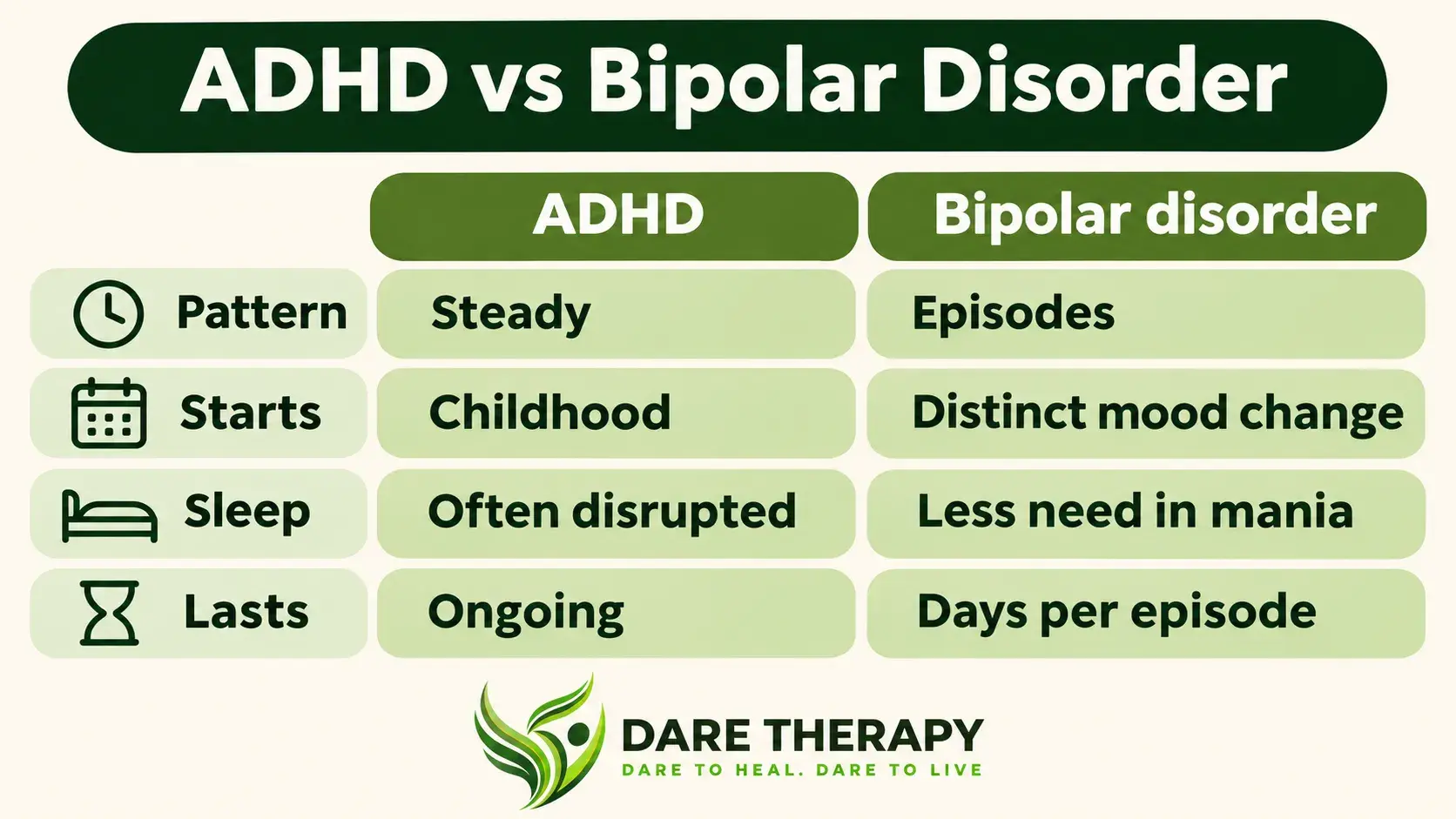
The biggest difference is the pattern. ADHD symptoms are steady. They start in childhood and show up most days, in most settings. Bipolar disorder comes in episodes. Your mood, energy and sleep shift away from your normal for days at a time, and then settle back down. Both can cause restlessness, racing thoughts, distraction and impulsive choices, which is why they get mixed up so often. It is also possible to have both.
If you are trying to figure out which one fits you, this guide lays the two side by side. It covers what they share, how they differ, how a provider tells them apart, and what treatment looks like for each. It also answers the questions people search most, like whether bipolar can be mistaken for ADHD and whether you can have both at once.
What is the main difference between ADHD and bipolar disorder?
ADHD is a lifelong pattern. Bipolar disorder is a mood condition that moves in waves.
With ADHD, symptoms begin in early childhood and can continue into adulthood. For an adult diagnosis, symptoms need to have started before age 12. They show up in more than one area of life, such as work and home, and they cause ongoing problems. Severity can change from one situation to the next, but there is no clear start and stop. The trouble focusing or the restlessness is simply there.
With bipolar disorder, you have mood episodes. During a manic or hypomanic episode, mood and energy go up. During a depressive episode, they go down. Each episode usually lasts several days, and some people have long stretches of feeling like themselves in between. The key point is the change from your own baseline. People often say “that was not me” when they look back at an episode.
So the simplest question to ask yourself is this: has this always been how I am, or does it come and go in stretches that feel different from my normal?
What do ADHD and bipolar disorder have in common?
Quite a lot, on the surface. Here are the symptoms that overlap.
- Restlessness and agitation. Adults with ADHD often feel restless. In a manic episode, people can have increased activity or agitation.
- Distractibility and trouble concentrating. Both conditions can make it hard to stay on one thing. Depressive episodes in bipolar disorder can also bring trouble concentrating or deciding.
- Impulsive choices. Impulsiveness is a core ADHD symptom. In mania, poor decisions such as spending sprees or risky choices are common.
- Talking fast. Rapid or excessive talking is listed among mania symptoms, and many people with ADHD also talk a lot or jump between topics.
- Mood swings and a short temper. Adults with ADHD often report mood swings and a quick temper. Bipolar disorder is built around mood shifts.
- Sleep problems. Sleep trouble is very common with ADHD. In bipolar disorder, sleep changes with the episode.
Because the surface looks alike, a quick look at one bad week can point to either one. The history is what separates them.
ADHD vs bipolar disorder: side by side
This table shows the main differences. Use it as a guide to what to bring up with a provider, not as a way to diagnose yourself.
| ADHD | Bipolar disorder | |
|---|---|---|
| Overall pattern | Steady, present most days | Comes in episodes, with a clear change from your baseline |
| When it starts | In childhood, before age 12 for an adult diagnosis | Appears as a distinct change from your normal |
| Mood | Mood swings and a quick temper are common | Mood shifts between elevated or irritable and low or hopeless |
| Energy | Restlessness or hyperactivity that tends to ease with age | Raised activity and energy during mania or hypomania, low energy during depression |
| Sleep | Sleep problems are common | Needing much less sleep during mania, sleeping too little or too much during depression |
| How long it lasts | Ongoing, across years | Each episode usually lasts several days, with calmer stretches between |
| Thinking | Trouble focusing, organizing and finishing tasks | Racing thoughts and distraction in mania, trouble concentrating in depression |
| Impulsivity | A steady trait | Poor decisions during manic or hypomanic episodes, such as spending sprees |
| Break from reality | Not listed among ADHD symptoms | Can happen in severe mania |
If you are asking yourself how to know if you are bipolar or have ADHD, the table points to the same answer each time. Look for the pattern over time, not one moment.
How does ADHD show up in adults?
Adult ADHD does not always look like the kid who cannot sit still. Hyperactivity often fades with age. Impulsiveness, restlessness and attention problems can stay.
Adults with ADHD often report disorganization, poor time management, trouble focusing, trouble finishing tasks, difficulty multitasking, poor planning, low frustration tolerance and trouble handling stress. Many adults do not realize they have it. Some are not diagnosed until adulthood, especially if they got by in school or if the symptoms were put down to something else.
ADHD also goes with strong feelings for a lot of people. If your emotions hit hard and fast, why ADHD makes you feel everything so intensely walks through that in detail. And if you have been told it was anxiety or depression, read about why ADHD in women gets mistaken for anxiety, depression or trauma.
How does bipolar disorder show up?
Bipolar disorder has two sides, and a person can feel very different from one week to the next.
Mania and hypomania. Both have the same kind of symptoms, but mania is more severe. Mania can cause a break from reality, called psychosis, and may need hospital care. Hypomania is milder. An episode involves three or more of these:
- More activity or agitation
- Inflated self confidence
- Needing much less sleep
- Fast or excessive talking
- Racing thoughts
- Distractibility
- Poor decisions, like spending sprees or risky sexual or financial choices
Depressive episodes. These involve five or more symptoms that make daily life hard, such as feeling empty, hopeless or tearful, losing interest in things, changes in weight, sleeping too little or too much, restlessness or slowed movement, fatigue, worthlessness or guilt, trouble concentrating and thoughts of suicide. If you recognize this list, signs of depression you should not ignore and different types of depression cover the depressive side in more detail.
The types. Bipolar I involves at least one manic episode. Bipolar II involves at least one major depressive episode and at least one hypomanic episode, with no manic episodes. Bipolar II is a separate diagnosis and not a milder form of bipolar I. Cyclothymia involves at least two years of frequent hypomanic and depressive symptoms that are less severe.
How long do bipolar episodes last compared with ADHD symptoms?
Mood episodes in bipolar disorder usually last several days each. Some people have them rarely. Others have several a year. Rapid cycling means four or more mood episodes in a year, and some people have long stable periods in between.
ADHD symptoms do not work that way. They are present over the long term, with ups and downs based on stress, sleep and the situation, but without distinct episodes that begin and end. If you can point to a stretch when you felt very different, with a clear start and end, that is worth telling your provider about.
Can bipolar disorder be mistaken for ADHD?
Yes, and it goes the other way too. Bipolar symptoms can overlap with other conditions, and what seems to be bipolar disorder may turn out to be something else, including ADHD.
It happens for a few reasons. A single visit may catch a person during a restless or distracted stretch, and that looks like ADHD. Or a person with ADHD may have a very intense week, with little sleep and a fast, jumpy mind, and that looks like mania. Without the longer history, either one can be read wrong.
That is why a careful evaluation looks at your whole life, not one snapshot. It also helps to know that depression and anxiety are often the first labels people get. If you are not sure who to see for this kind of sorting out, psychiatrist or therapist explains who does what.
Can you have ADHD and bipolar disorder at the same time?
Yes. ADHD is listed among the conditions that can occur alongside bipolar disorder. In the other direction, mood disorders such as depression and bipolar disorder are common in adults with ADHD.
ADHD does not directly cause these conditions. They just often show up together. When they do, treatment becomes harder, because each condition can make the other one more difficult to manage. This is a main reason to see a provider who looks at both, and not one who treats only the symptom that is loudest on the day of the visit.
How do providers tell ADHD and bipolar disorder apart?
Through a full evaluation, not a single test. A provider builds a timeline of your symptoms and checks for other causes.
For ADHD in adults, providers rely heavily on your past. They may:
- Talk with people who know you well, such as family, friends or a partner
- Look at school reports or other childhood records
- Use interviews, symptom checklists or rating scales
- Give psychological tests that look at memory, planning and reasoning
- Review your mood history and medical history to rule out other conditions
For bipolar disorder, an evaluation may include:
- A physical exam and lab tests, to check for medical problems that could cause the symptoms
- A mental health assessment covering your thoughts, feelings and behavior patterns, which may include questionnaires
- Mood charting, which means keeping a daily record of moods, sleep and other factors
- Input from family or close friends, with your permission
Because the two overlap, a good evaluation looks at both sets of questions. Here is what often helps you get the most out of the visit:
- Write down your timeline. Note when symptoms started and whether there were stretches that felt very different from your usual self.
- Track your mood and sleep for a couple of weeks. A simple daily note on mood, energy and hours slept gives your provider real data.
- Gather childhood details. Old report cards, teacher comments or a parent’s memories can help, since adult ADHD depends on childhood symptoms.
- Ask someone who knows you well to share what they have noticed. Others often spot the shifts you miss, especially during elevated episodes.
- Bring a list of everything you take. Medicines, supplements, caffeine, alcohol and other substances can all affect mood and focus.
What is mood charting, and how does it help?
Mood charting is a daily record of your mood, sleep patterns and other factors that may affect how you feel. You can use a notebook or an app.
It helps because bipolar disorder is about change over time, and memory is a poor way to track that. A chart can show you things like a few nights of very little sleep without feeling tired, followed by a week of low mood. That kind of pattern is hard to see in the moment and much easier to see on paper. It can also help spot triggers and guide treatment changes once you have a diagnosis.
Why does getting the right diagnosis matter?
Because the two conditions are treated differently.
For ADHD in adults, medication is usually a stimulant, and psychotherapy such as behavioral or cognitive behavioral therapy is the other main option. Treatment often combines approaches, and people sometimes need to try several before they find what works.
For bipolar disorder, medicines such as mood stabilizers and antipsychotics are the main tools. Antidepressants are added with caution, because they can trigger mania or hypomania, and they are usually paired with a mood stabilizer or an antipsychotic. That is one clear example of why the diagnosis changes the plan: a step that makes sense for one condition can cause trouble in the other.
If you want to know more about how our approach works for medicines in general, online medication management and medication reviews explain how follow up works. For a plain look at how therapy and medicine fit together for other conditions, see how anxiety treatment works with therapy and medication and how depression treatment works with therapy and medication.
How is bipolar disorder treated?
Bipolar disorder is a lifelong condition, and treatment is aimed at managing symptoms. Most people do well with a plan that mixes medicine and talk therapy.
Medicines. The main groups are mood stabilizers, antipsychotics and, with care, antidepressants. Finding the right medicine often takes trial and error, and changes are usually made one at a time. Short term anti anxiety medicines may be used in some cases.
Talk therapy. Several types are used:
- Interpersonal and social rhythm therapy helps steady daily routines for sleep, waking and eating.
- Cognitive behavioral therapy helps you identify triggers and replace unhelpful beliefs and behaviors.
- Psychoeducation teaches you about the condition so you can spot warning signs.
- Family focused therapy improves communication and support at home. Signs your family might need therapy is a good place to start if that sounds relevant.
Long term care. Medicine usually continues long term, even when you feel well. Stopping can bring symptoms back or let mood changes slip into mania or depression, so any change should be talked through with a provider first. Regular routines for sleep, food and exercise, avoiding alcohol and drugs and keeping a mood chart all support treatment.
You can read about bipolar disorder care at Dare Therapy for more.
How is adult ADHD treated?
The main options are medicine and talk therapy, and many adults use both.
Medicine. For adults, medication is usually a stimulant. Not everyone needs it, and not everyone does well on the first one. Providers often adjust the plan over time.
Therapy. Behavioral therapy and cognitive behavioral therapy both help with the day to day side of ADHD, such as planning, time and follow through. Types of ADHD therapy for adults explains what each one works on, and online ADHD therapy describes how sessions run.
Other supports. Some adults use an ADHD or life coach to build skills for planning and organization, and regular exercise can help. Adults whose symptoms affect their work may also qualify for workplace accommodations.
For adults who want an assessment first, adult ADHD evaluations and prescribing covers that step.
What if you have both ADHD and bipolar disorder?
Treatment has to account for both. Each condition can make the other harder to manage, so the plan usually needs more care and more follow up than for either one alone.
Your provider will keep checking how your mood, sleep and energy respond as treatment changes. The mood chart matters even more here, because it helps show whether a change in focus or energy is coming from ADHD or from a mood shift.
If you also feel anxious much of the time, depression and anxiety together and medication management for anxiety and depression cover how those fit in.
When should you see a provider?
See a provider if any of these sound like you:
- Your focus, planning or restlessness keeps disrupting work, school or relationships.
- You have stretches of very little sleep, racing thoughts, high energy or risky decisions that feel unlike you.
- You have stretches of low mood, emptiness or hopelessness that last days or weeks.
- Your moods swing and you cannot tell whether it is ADHD, a mood condition or something else.
- A family member has bipolar disorder and you are noticing mood changes in yourself.
- You have been told you have anxiety or depression, and treatment has not helped.
Bipolar disorder does not get better on its own. Look for a provider with training and experience treating adults with ADHD, since some people are not diagnosed until adulthood.
If you are having thoughts of suicide, call or text 988. If you are in immediate danger, call 911.
If you are not sure whether to start with a therapist or a medication provider, psychiatrist or therapist explains the difference, and how to choose therapy helps you pick a starting point.