

You get cut off in traffic and you’re furious for the next ten minutes. A coworker’s “can we talk?” message sends your stomach to the floor. Someone says something mildly critical and you’re still chewing on it at 2 a.m. Sound familiar? If you have ADHD, or think you might, this is a very common way for it to feel.
One thing to get straight first. Big emotions aren’t part of how ADHD is officially diagnosed. That’s still about attention, restlessness and impulsivity. But the link is real, adults with ADHD do tend to have a harder time managing feelings, and ignoring that side of things leaves a big piece of the picture out. We’ll walk through why it happens, what it can look like, how to tell it from anxiety or depression, and what helps. Therapy, mostly, plus a few small habits and, where it fits, medication.
Is intense emotion actually part of ADHD?
Kind of. It isn’t on the official checklist, but it keeps turning up.
Doctors diagnose adult ADHD by counting symptoms of inattention, hyperactivity and impulsivity. Five or more from one group, present before age 12, causing trouble in more than one part of life. Mood isn’t on that list.
Still, when researchers pooled 22 studies of adults with ADHD, the adults consistently had a rougher time regulating emotions than adults without ADHD. In many of the studies the gap was medium to large. The authors were careful about it, though. The evidence was patchy, and because emotional trouble shows up in other conditions too, they stopped short of calling it a core symptom. What they did say is that it causes real difficulty and deserves attention in treatment.
Everyday descriptions of adult ADHD back this up. Frequent mood swings, a hot temper, trouble handling stress and low tolerance for frustration all appear on standard symptom lists. So if ADHD has always felt emotional to you, you weren’t imagining it.
Why does ADHD make emotions feel so big?
Honestly, nobody has the full answer yet. Researchers are still sorting it out. A few things seem to feed into it.
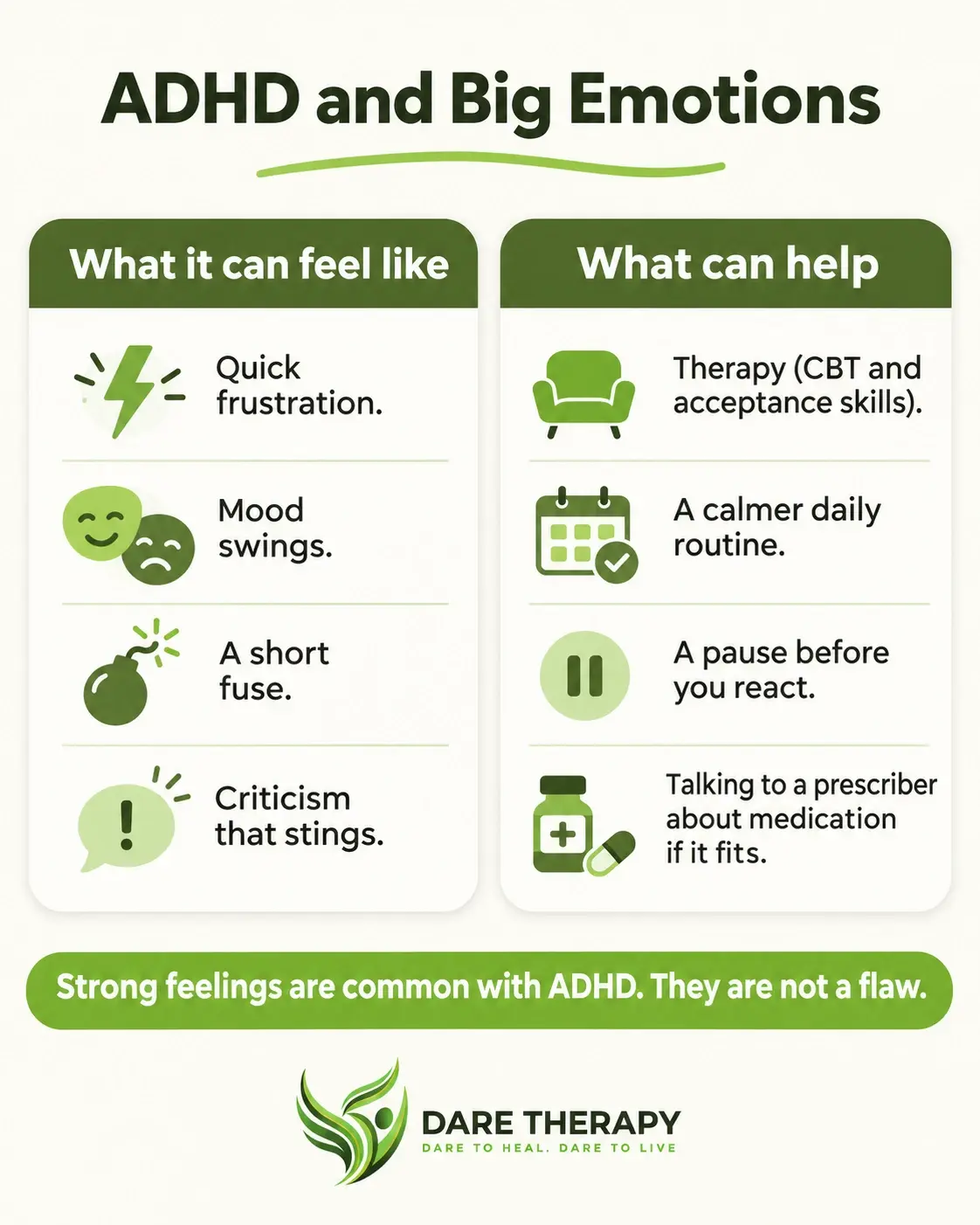
Take impulsivity. It doesn’t only apply to buying things or blurting out answers. It can apply to feelings. A flash of hurt or irritation goes straight to the mouth, or the door, before the little pause that usually gives you a second thought. Impulsiveness in ADHD can look like impatience, and sometimes like sudden anger.
Then there’s the history. Plenty of adults with ADHD have spent years getting corrected for stuff that was genuinely hard for them, forgetting things, losing track of time, missing details. That wears on a person. Low self-worth, sensitivity to criticism and a harsh inner voice are all described in adults with ADHD, and they’re often tied to that long run of feedback.
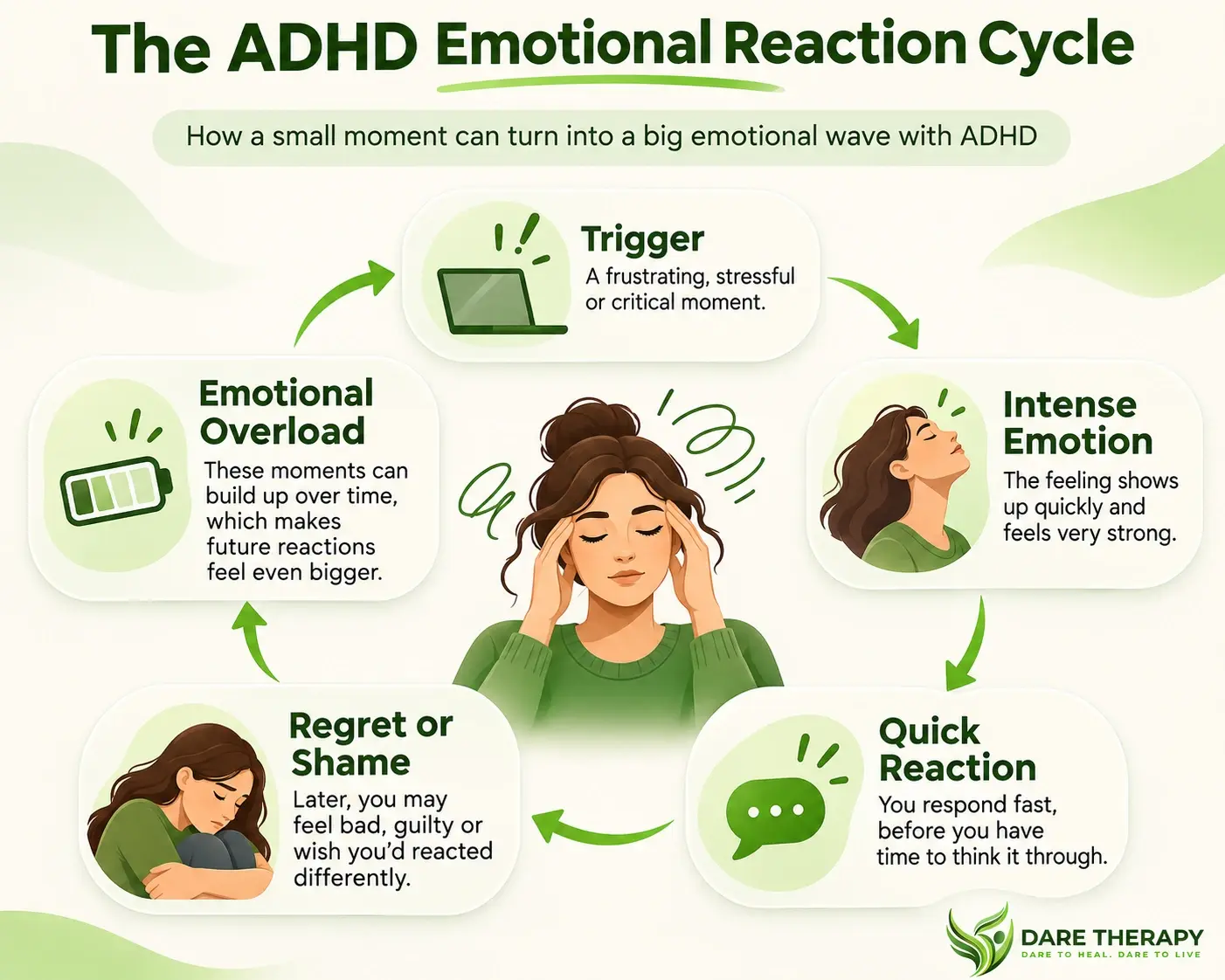
Daily stress matters more than people admit. If your morning already included lost keys, a missed email and a deadline you forgot, there’s less patience left for the next thing, and a small annoyance at 6 p.m. can feel huge because the tank was empty hours ago. Chronic frustration, guilt and blame come up a lot in adults dealing with ADHD at work, at home and in relationships.
And the strategies matter. In that same review, adults with ADHD leaned more on holding feelings in than on reframing them. Holding it in works for a minute. Then it comes back louder, which is why a reaction can seem to explode out of nowhere when it’s really been building all day.
What does emotional intensity with ADHD look like day to day?
It’s different for everyone, but a few things come up over and over.
Frustration is fast. A slow checkout line, a frozen laptop, someone interrupting right when you finally got started on something, and you’re boiling. Often you notice later, once it’s passed, and wonder why that got such a big reaction.
Mood can swing in a way that confuses everyone, including you. Fine in the morning, flat or edgy by lunch, no obvious reason. People call it moodiness, which only adds shame to the pile.
Stress hits differently too. When tasks stack up, some people get snappy, some go quiet and shut down, some end up crying in the car. A small pile feels like a flood.
Criticism sticks. A tone in an email, an offhand comment from your boss, a friend who hasn’t texted back, and you’re replaying it for hours. Sometimes days.
After a flare-up of anger or a dropped commitment, many people stew in guilt for far longer than the incident lasted. That matters, because the shame feeds the next flare-up.
It isn’t all painful, either. Many people with ADHD describe loving things hard, getting excited fast and feeling deeply for the people around them. It’s the same dial, turned up in every direction.
Why does criticism and rejection hit so hard with ADHD?
Part of it is history, and part of it is speed.
If you’ve heard “try harder” your whole life, a new bit of feedback, even a mild one, can plug straight into an old sore spot. It doesn’t land as one comment. It lands as the hundredth. That’s the sensitivity to criticism clinicians describe in adults with ADHD.
You may have seen this called “rejection sensitivity” online. It’s a popular way to describe the experience. It isn’t an official diagnosis, and the research on it is still young. What’s solid is the pattern underneath: many adults with ADHD feel criticism, or the possibility of it, very strongly and have trouble letting go.
It helps to pull the feeling apart from the facts. The coworker who didn’t say hi may be buried in work. A short reply may just be a short reply. Therapy is good at exactly this kind of checking, and we’ll get to it below. If a lot of your pain comes from replaying social moments afterward, overthinking and anxiety looks at how that loop works.
Is it ADHD, anxiety, depression or something else?
Often it’s more than one, so it’s worth a careful look.
ADHD travels with other conditions a lot. Anxiety, depression and other mood disorders are all common companions, and the repeated setbacks of untreated ADHD can make depression worse. Worry can grow when ADHD makes everyday life harder to run. Depression and anxiety together explains how closely those two overlap, and ADHD can sit on top of both.
It goes the other way too. Mood disorders, thyroid problems and substance use can all look like ADHD. And because emotional ups and downs appear in conditions beyond ADHD, like bipolar disorder or certain personality disorders, intense feelings alone can’t tell anyone which it is. One symptom isn’t a diagnosis.
So a full evaluation matters. A good provider asks about your history, how long things have been going on, whether they show up at work and at home, and what else might be driving them. There’s no blood test or scan for ADHD, so your story carries weight. For more on how often ADHD gets mixed up with other things, especially in women, see why ADHD in women gets mistaken for anxiety, depression or trauma. And if you’re curious about how different brains work in general, neurodivergence goes wider.
How does emotional intensity affect relationships and work?
More than most people expect.
ADHD can lead to unstable relationships and a poor self-image, and emotional flare-ups are part of that. A partner gets hurt by a quick temper, then feels confused when it passes and you act like it’s over. You feel awful about the fight and don’t know how to repair it. At work, one blunt piece of feedback can wreck a whole afternoon.
The people closest to you take the heat. Distance, resentment and that walking-on-eggshells feeling can build on both sides. If this sounds like home, why do I feel distant from my partner gets at the disconnect, and virtual couples therapy gives you both a place to work on it. If temper is the sticking point, how to control anger before it controls you has practical steps.
None of this means anyone is doing something wrong. A lot of it is a pattern two people can learn to see, and then change.
Can therapy help with the emotional side of ADHD?
Yes. For many people this is where therapy really earns its place.
Counseling for adult ADHD usually mixes talk therapy, education about ADHD and skills training. Cognitive behavioral therapy (CBT) is the structured kind, and it teaches skills for managing behavior and replacing negative thought patterns. It can help with trouble at work and in relationships, and with things like depression. Dare’s approach is covered on the online CBT therapy page.
It also goes beyond planners and time management. Counseling can help you cope with old setbacks, build self-esteem, repair relationships with family, coworkers and friends, and get a handle on temper. Those are often the pieces adults with ADHD care about most.
What does that look like in a session? A few things come up.
You learn to catch a feeling a little earlier. “I’m getting frustrated” said to yourself five seconds sooner gives you room to decide what to do with it.
You try other tools besides holding it in. The research on adults with ADHD suggests that reframing a situation may serve them better than just pushing the feeling down, and a therapist can show you how to do that.
You test the story. When a comment stings, you and your therapist look at what actually happened and what got added in your head. That’s the core of CBT.
You practice noticing without obeying. Acceptance and commitment therapy is built around that, and it suits people who feel flooded. Early research on mindfulness for adults with ADHD looks promising, though it’s still preliminary.
And you work on the shame. A surprising amount of ADHD therapy is quietly about self-esteem after years of being told you weren’t measuring up.
For one to one work, take a look at online individual therapy, and for ADHD in particular, online ADHD therapy. Not sure what kind of therapy fits? How to choose therapy walks through it, and how therapy helps covers what to expect.
What can you try between sessions?
Small habits won’t replace treatment, but they can sand down the rough edges.
Start by making your day less crowded. A short daily task list, big jobs broken into smaller steps, checklists, reminders and a steady routine are standard advice for adults with ADHD, and they cut the daily friction that feeds frustration. Fewer little failures means less fuel for the big reaction.
Look at your sleep. Sleep problems are very common with adult ADHD (up to 70% of adults, by one estimate), and when you’re short on rest, feelings tend to hit harder. Mention it to your provider if you’re struggling.
Try the pause. Ten seconds. Step back from the message you’re about to fire off, take a slow breath, let the first wave go by. It won’t solve everything, but it gives you a shot at picking your words.
Let people in on it. When family and friends understand what’s going on, they can meet you halfway. A plain “I get overwhelmed fast and might need a minute” can head off a lot of fights.
Move your body when you can. Exercise is a common suggestion in ADHD care, and healthy ways to manage daily stress has more ideas.
And go easy on yourself afterward. The second wave of shame after a flare-up often does more damage than the flare-up did. Talk to yourself like you’d talk to a friend. It happened, it can be repaired, and you’re allowed to move on.
Where does medication fit in?
It can play a part, and that’s a conversation for a prescriber.
ADHD is most often treated with behavioral therapy and medication together, adjusted over time. Medication can help with focus and attention, which can ease the daily stress that feeds emotional reactions. The review we mentioned earlier also found two randomized trials where certain ADHD medicines reduced emotional dysregulation compared with placebo. That’s encouraging. It’s a small body of evidence, though, and medicine isn’t the answer for everyone.
People respond differently, and finding the right fit can take a while. A prescriber can go over benefits, risks and side effects with you, and nobody should change or stop a medicine on their own. If you’d like to explore it, Dare offers online medication management, which can run alongside therapy as part of the same care.
When should you reach out for help?
When big emotions are straining your relationships, your work, your sleep or your peace of mind. That’s reason enough.
Maybe the same argument keeps repeating. Maybe shame hangs around for days, or you regret how you reacted, or you feel on edge all the time, or your mood sits low. You don’t need to wait until it’s “bad enough.” And if you’ve never been evaluated for ADHD but this reads like your life, an assessment can tell you whether it’s ADHD, something else, or both.
If you ever have thoughts of hurting yourself, call or text 988 any time to reach the Suicide and Crisis Lifeline. If you’re in danger right now, call 911.