

Most people need somewhere between 5 and 15 sessions of cognitive behavioral therapy (CBT) for anxiety, and many land around 8 to 12. Sessions usually run 45 to 60 minutes, and they’re often weekly at the start, then every other week as things improve. Some people feel relief within a handful of sessions. Others need several months. Anxiety that has been around for years, or that comes with other problems like depression, can take a year or longer.
So there’s no single number. What you need depends on how long the anxiety has been going on, how strong it is, what else is happening in your life, and how you respond to treatment. This post goes through each of those, plus how often to go, what the first few sessions look like, how to tell whether therapy is working, and what to do if it isn’t.
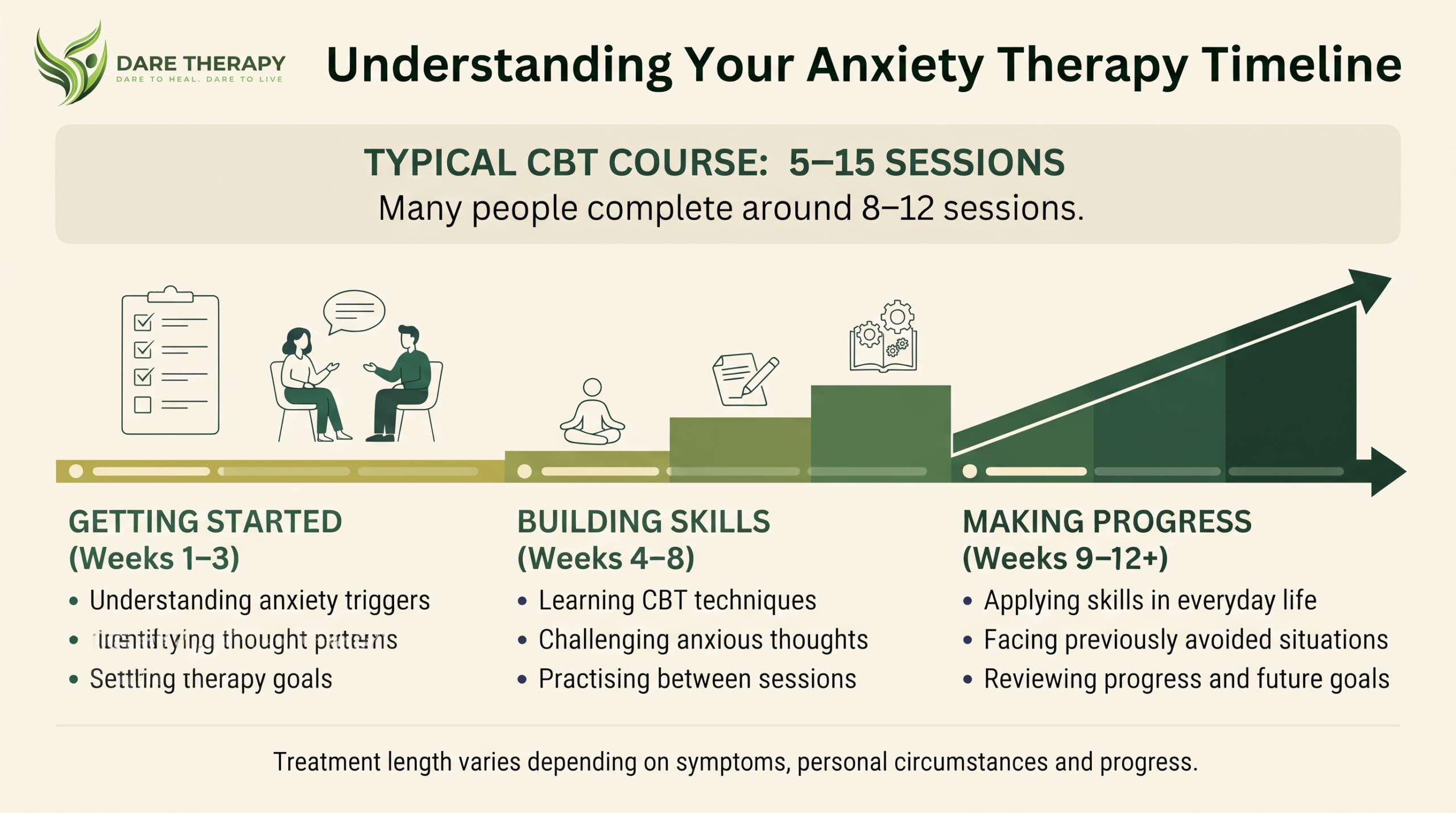
How many therapy sessions do you need for anxiety?
For CBT, the most studied therapy for anxiety, a typical course is 5 to 15 sessions. Many people finish somewhere in the range of 8 to 12. Those are ranges, not rules. Some people feel noticeably better after a few sessions and stop there. Others keep going, because they want to work on more than the anxiety, or because progress is slower than they hoped.
Longer treatment isn’t a sign that something is wrong. A therapist might suggest more sessions if symptoms haven’t eased after the first round, if you have more than one problem to work on, or if you’ve dealt with anxiety most of your life. Therapy for an ongoing, long-term mental health concern can last a year or more.
It also works the other way. Some people get what they need in a few weeks, especially when the anxiety is tied to one situation, like a job change or a stressful stretch.
If you want to know where you’d fall, ask your therapist in the first few sessions. Once they’ve heard your history, they can usually give you a rough estimate, and you can adjust it as you go.
How long does it take for anxiety therapy to start working?
Many people start feeling a difference somewhere around six to 12 sessions. A few feel relief after a single session. A good number notice small changes in the first weeks, like falling asleep a bit faster or catching a spiral earlier, before anything big shifts.
Don’t expect instant results. Therapy builds skills, and skills take practice. In the early weeks you’re mostly learning what your anxiety looks like, what sets it off, and what keeps it going. The real change often shows up once you start using what you’ve learned between sessions.
Time matters too. If you go once a week and do the practice in between, progress usually shows up faster than if you go rarely and skip the practice.
How often should you go to therapy for anxiety?
Weekly is the usual starting point. Sessions can also be every other week or even monthly, depending on your needs.
A common pattern looks like this. You start weekly so your therapist can get to know you and you can build momentum. Once you’re using the skills and feeling steadier, you might move to every two weeks. Later on, some people check in monthly, or come back only when things get hard.
There isn’t a rule that says you must go every week forever. Therapy isn’t necessarily years of weekly treatment. At the same time, going too rarely at the start can slow things down, because there’s a lot of ground to cover in the first month.
How long is each anxiety therapy session?
Usually 45 to 60 minutes. Therapists often call it a “50 minute hour.”
The first session can feel different, and it may run longer or need a second sitting. Your therapist is gathering background, so you’ll talk about why you came in, what your days look like, your sleep and appetite, your family history, and what you’ve already tried.
What decides how many sessions you need?
A handful of things push the number up or down.
Start with how long you’ve had anxiety. Anxiety that began a few months ago, after a clear event, tends to move faster than anxiety you’ve carried since your teens. Longer patterns have more habits to unlearn.
Strength matters too. Mild to moderate anxiety that you can mostly manage may need fewer sessions than anxiety that hits your sleep, work, relationships and health every day.
Then there’s the type. Panic attacks, social anxiety, constant worry and fear of specific things all respond to therapy, but each has its own focus. Panic work often involves facing physical sensations. Social anxiety work often involves facing situations. Constant worry work often involves learning to notice and question the worry. You can read more about the difference in anxiety vs. panic attacks, and about social anxiety signs and treatment.
What else is going on counts a lot. If you’re also dealing with depression, trauma, grief or relationship stress, your therapist may spend time on those too. See depression and anxiety together for how they overlap. A big move, a new baby, a loss or a job in trouble can slow things down as well, because there’s always something new setting you off.
Practice is a big one. Most CBT includes exercises between sessions, and people who do them tend to move faster. And so is fit. Trust and comfort matter, and if you don’t feel understood, progress usually stalls.
Your therapist weighs all of this together, and the plan can change as they learn more.
What happens in the first few sessions?
Mostly getting to know you.
In session one, your therapist usually asks what brought you in, what the anxiety feels like, how long it’s been there, and how it affects your daily life. They may ask about sleep, appetite, work, relationships and family history. Some of this takes more than one session.
By the end of the first few sessions, you should have a clearer picture of what’s going on, a plan, and a sense of what you’ll be working on together. That plan often includes goals, like “go to the grocery store without leaving early” or “stop checking my phone for bad news every ten minutes.” Your therapist might write them down so you can both see progress.
This is also the time to check the fit. Ask how many sessions they expect, how they’ll measure progress, and what happens if things aren’t moving. A good therapist welcomes these questions. If you’re still deciding what kind of therapy suits you, how to choose therapy walks through the options.
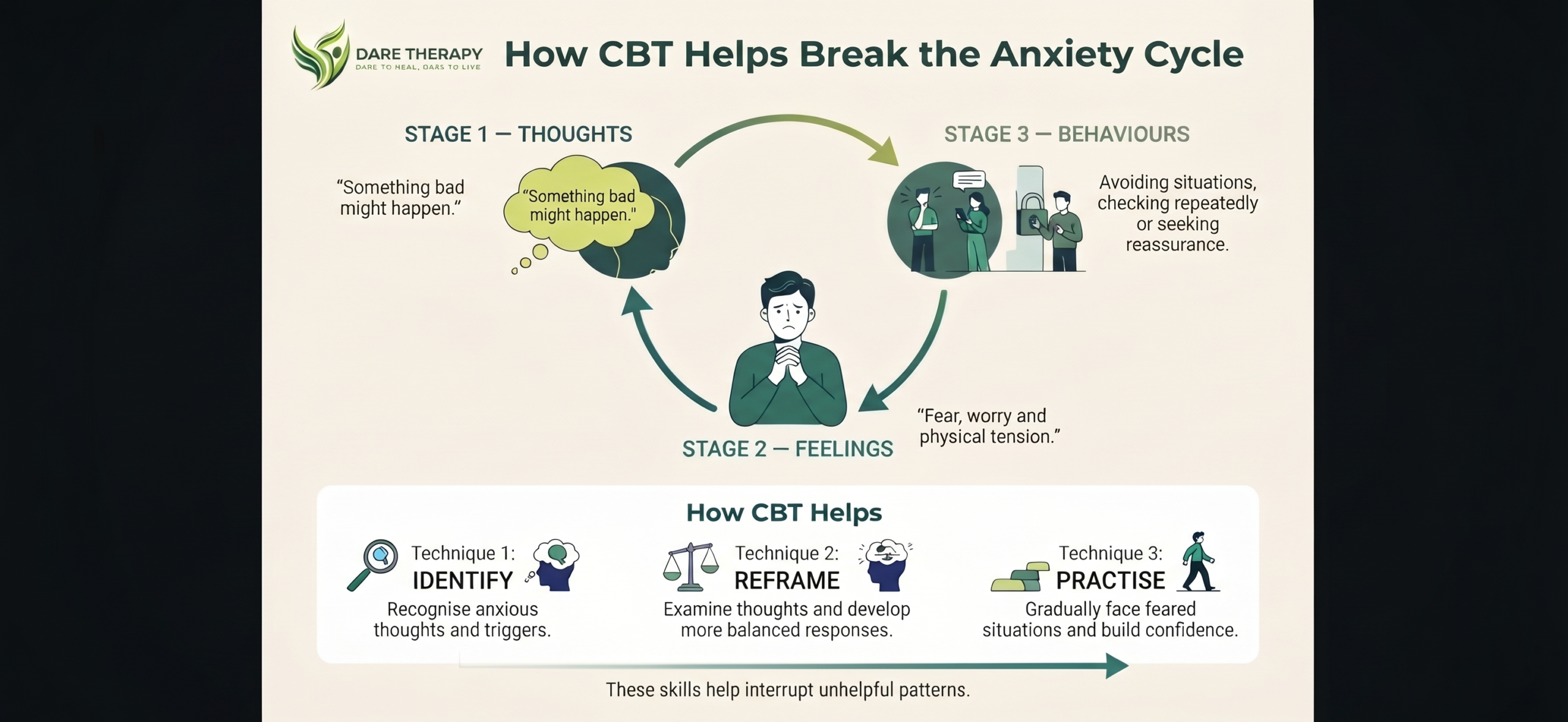
What actually happens in CBT for anxiety?
CBT looks at the link between what you think, how you feel and what you do. The idea is that anxious thoughts (“something is going to go wrong”) trigger anxious feelings and behaviors (avoiding, checking, over-preparing), and those behaviors keep the anxiety going.
In sessions, you and your therapist go over difficult situations and how they affect your thoughts, feelings and actions. You learn to notice automatic thoughts, test whether they’re accurate, and try different responses. You also work on behavior, such as gradually returning to things you’ve been avoiding.
Many people also work on exposure, a type of CBT where you face feared situations or sensations in small steps, in a supportive setting, until the fear goes down. The pace is set with your therapist, and you don’t have to jump into the hardest thing first.
Between sessions, you’ll usually practice what you’ve learned. That might mean tracking your anxiety in a notes app, trying a new response when a worry shows up, or taking a small step toward something you’ve been avoiding. If you want to see how Dare approaches it, there’s more on online CBT therapy in Boston, and some people prefer acceptance and commitment therapy, which focuses on noticing anxious thoughts without acting on them automatically.
Can therapy make anxiety feel worse before it gets better?
Yes, sometimes. It’s common, and it doesn’t mean therapy is failing.
Talking about what scares you can stir things up at first. And exposure work means deliberately feeling a bit of the anxiety you’ve been avoiding, which is uncomfortable by design. It tends to ease as you repeat it.
If it ever feels like too much, say so. Your therapist can slow down, change the order of steps, or use more grounding skills along the way. You’re not supposed to white-knuckle through everything.
Does homework really matter?
It does, and it’s one of the biggest reasons some people finish in 8 sessions and others take 20.
Practice between sessions is what turns ideas into habits. If you only think about anxiety for an hour a week, change is slow. If you try a small experiment every day, even a five minute one, the work compounds.
Homework doesn’t have to be heavy. Keep it small and doable. And tell your therapist honestly when you couldn’t do it. That’s useful information, and the plan can change to fit your life.
How do you know if therapy is working?
Progress rarely looks like the anxiety disappearing. More often it looks like small, steady changes.
You might notice that you feel understood by your therapist, and the plan makes sense to you. You might be sleeping a bit better, worrying a bit less, or recovering faster after a bad day. You might start doing things you used to avoid. Friends or family might point out a change before you notice it yourself.
Your therapist should also track progress with you. Some use short questionnaires every few sessions, others check against the goals you set at the start. If you don’t know how progress is being measured, ask.
Another sign: you stop lying awake worrying about the original problem, or the thing that felt huge a few months ago barely registers.
What if you’re not getting better after several sessions?
Say something. That’s the most useful move.
If you haven’t felt any benefit after several sessions, talk with your therapist about it. They might change the approach, add something new, try a different type of therapy, or adjust how often you meet. Sometimes it takes a second course of treatment, with more sessions, to see real change.
It’s also fine to ask whether a different therapist would fit better. Trust and comfort matter in therapy, and a poor fit isn’t your fault. If you’re unsure where to start, the overview in how therapy helps explains what to expect from different approaches.
Sometimes a medication check helps too, which we’ll get to below.
What should you ask your therapist about timing?
Ask early. A good therapist expects these questions and won’t mind them.
Do you recommend a set time frame or number of sessions for what I’m dealing with? How will we measure progress? What happens if I, or you, feel I’m not starting to improve? How long are sessions, and how often should we meet at first? What do you want me to practice between sessions?
You can also ask what the first month will look like. That gives you a picture of how the plan is supposed to unfold, so a slow week doesn’t catch you off guard. Therapy goes best when you treat it as a partnership where you set goals together.
What helps therapy work faster?
A few simple habits make a real difference.
Show up consistently. Missing sessions makes it harder to build on what you did last time. If you can’t make one, reschedule soon.
Be honest, even about things that feel embarrassing. Your therapist can only work with what they know. If a thought or habit seems silly or shameful, that’s usually the one worth bringing up.
Do the practice, even in small doses. Trying something for five minutes a day beats waiting for the perfect hour on Sunday.
Keep notes. A running list in your phone of when anxiety hit, what you were doing and what helped gives your therapist real material to work with. It also shows you progress you’d otherwise forget.
And be patient with the process. Anxiety took time to build and it takes time to loosen. Small wins count.
When can you stop or space out sessions?
Signs you may be ready to wind down include: your goals are mostly met, the original problem isn’t taking up your evenings anymore, you can handle spikes without a spiral, and people around you notice the difference.
You and your therapist decide this together. Many people taper, moving from weekly to every other week to monthly, before stopping. That gives you a chance to see how you manage with more room between sessions.
Stopping doesn’t mean you can never come back. Stress, big changes and hard seasons can bring anxiety up again. Getting help early, as soon as symptoms start to creep back, usually keeps it from disrupting your life as much.
Do you need medication on top of therapy?
Not always. Many people do well with therapy alone. Others add medication, or use it first if anxiety is severe enough that it’s hard to start therapy at all.
Treatment often involves psychotherapy, medication, or both. Some antidepressants are used for anxiety, and they can take several weeks to start working. Fast-acting options exist, but they’re generally for short-term use because the body can build up a tolerance. Medicine can reduce symptoms, but it doesn’t teach the skills that therapy does. And no one should stop or change a dose without talking to their prescriber first.
If you’re weighing the two, anxiety treatment: therapy, medication, or both goes through the decision, and online medication management in Boston explains what a medication visit involves.
Does online therapy change how many sessions you need?
The number of sessions is driven by the same things we covered above. The format, in person or by secure video, doesn’t change the basics of how therapy works. CBT can be done in person, online or on the phone. Sessions are the same length, and the same homework applies.
What changes is convenience. There’s no commute, you can fit sessions around work, and you can attend from your own space. That can make it easier to show up every week, which helps momentum.
If you’re curious how it compares with seeing someone in an office, read about the benefits of online mental health therapy and how effective online therapy is.
Is it normal to still feel anxious after therapy?
Yes. Therapy doesn’t remove anxiety altogether. Everyone feels anxious sometimes, and that’s part of being human.
The goal is to make anxiety manageable, so it stops running your decisions. After treatment, many people still get nervous before a big meeting or a tough conversation. The difference is that they can handle it. If the same patterns come back strongly later, that’s a good time to check in again.
For everyday stress that isn’t quite an anxiety problem, healthy ways to manage daily stress is a good companion. And if you’re not sure whether what you feel needs therapy at all, does your anxiety need therapy or will it go away can help you sort that out.
Starting anxiety therapy online with Dare Therapy
Dare Therapy offers online anxiety therapy in Boston and across Massachusetts through online anxiety therapy in Massachusetts. Sessions happen over secure video, and our therapists are licensed in Massachusetts. In the first few sessions, we go over what you’re dealing with, set goals together, and talk about how long treatment might take for you.
Our broader anxiety counseling in Boston page has more on how we work, and you can meet our team before you book.
To get started, contact us.