

When Should You Get a Second Opinion on Psychiatric Medication?
You can ask for a second opinion on psychiatric medication at any point. The most common reasons are no real improvement after enough time, side effects that don’t go away, a diagnosis that doesn’t feel right, or a sense that your concerns aren’t being heard. It is a normal request, and most providers take it well.
A second opinion means another qualified provider looks at your history, your diagnosis and your medicines, then gives you their own view. They might agree with your current plan. They might suggest a change. Either answer gives you something useful.
This post covers the signs that it may be time, how long to wait before deciding a medicine isn’t working, what to avoid doing while you decide, what to bring and ask, and what the visit looks like.
What Is a Second Opinion on Psychiatric Medication?
It is a separate review of your care by a different prescriber. You share what you’ve been diagnosed with, what you take, how long you’ve taken it and how it’s going. The new provider asks their own questions and tells you what they think.
A second opinion is not the same as leaving your current provider. Many people get one and then go back to their original prescriber with new information. Others decide the second provider is a better fit. Both are fine.
At Dare Therapy, our medication reviews and second opinions are built for this. A provider goes over your current medicines, your treatment history, your symptoms, how you’ve responded and what worries you about your care.
Is It Normal to Want a Second Opinion About Psychiatric Medication?
Yes. Prescribing in mental health involves judgment calls, and two careful prescribers can look at the same symptoms and choose different paths. That is not a sign that one of them is wrong. It is a sign that this part of medicine isn’t a simple lookup.
Part of the reason is that no single medicine works for everyone with a given condition. Several different medicines can treat the same disorder, and each one works well for some people and not for others. Finding the right one often takes trial and error, even in good care.
So wanting another view doesn’t mean you distrust your provider. It usually means something isn’t sitting right, and you want to know whether it should.
What Are the Signs It May Be Time for a Second Opinion?
Any of the situations below is a fair reason to ask. You don’t need all of them.
Your symptoms haven’t improved after enough time
Every medicine has its own timeline, so “enough time” depends on what you take. Antidepressants, for example, usually take about 4 to 8 weeks to work, and sleep, appetite, energy and focus often get better before mood does. If you’ve passed the expected window and nothing has moved, that is worth raising. Waiting forever for a medicine that isn’t working takes time you may not want to lose.
Your provider may change the dose, switch to a different medicine or add a second one. If you’ve already been through a few of those steps without relief, a new set of eyes can be useful.
The side effects are hard to live with
Early side effects are common and often ease within a couple of weeks as your body adjusts. Upset stomach, headache and sleep changes are common examples. But some side effects stay. If you feel worse because of the medicine, or you dread taking it, tell your provider. If the conversation goes nowhere, another provider may see options your current one hasn’t offered, like a different dose schedule, a slower build up or another type of medicine.
It worked at first, and then stopped working
Some people find that a medicine helps for a while and then symptoms creep back. This happens often enough that it’s a known pattern. It doesn’t mean you did anything wrong. It may mean your plan needs another look.
Your diagnosis doesn’t feel right
Mental health diagnoses rely on what you describe and what the clinician sees, with no blood test to settle it. The same symptoms can lead one prescriber to one diagnosis and another prescriber to a different one, and the treatments change with the diagnosis. Some people go a long time on the wrong label before someone else sees it differently.
If the medicine you take is built for a condition that doesn’t match your experience, a second opinion on the diagnosis can matter as much as a second opinion on the medicine. It is also why careful evaluation matters when symptoms overlap, as they do with ADHD and bipolar disorder, or with depression and anxiety together.
You feel rushed, dismissed or unheard
If you leave appointments feeling that your concerns were brushed aside, that matters. You are allowed to want a provider who listens. Feeling dismissed is one of the most common reasons people look for another view, and it’s a good enough reason on its own.
You’ve had a lot of changes and no clear reason for them
If the dose has changed again and again, or a new medicine keeps getting added, and you can’t say why, ask for an explanation. If the explanation doesn’t make sense to you, a second opinion can test the logic.
You want to hear about other options
You might not be unhappy at all. You may simply want to know what else exists, including less invasive choices or a different mix of medicine and therapy. Asking is reasonable.
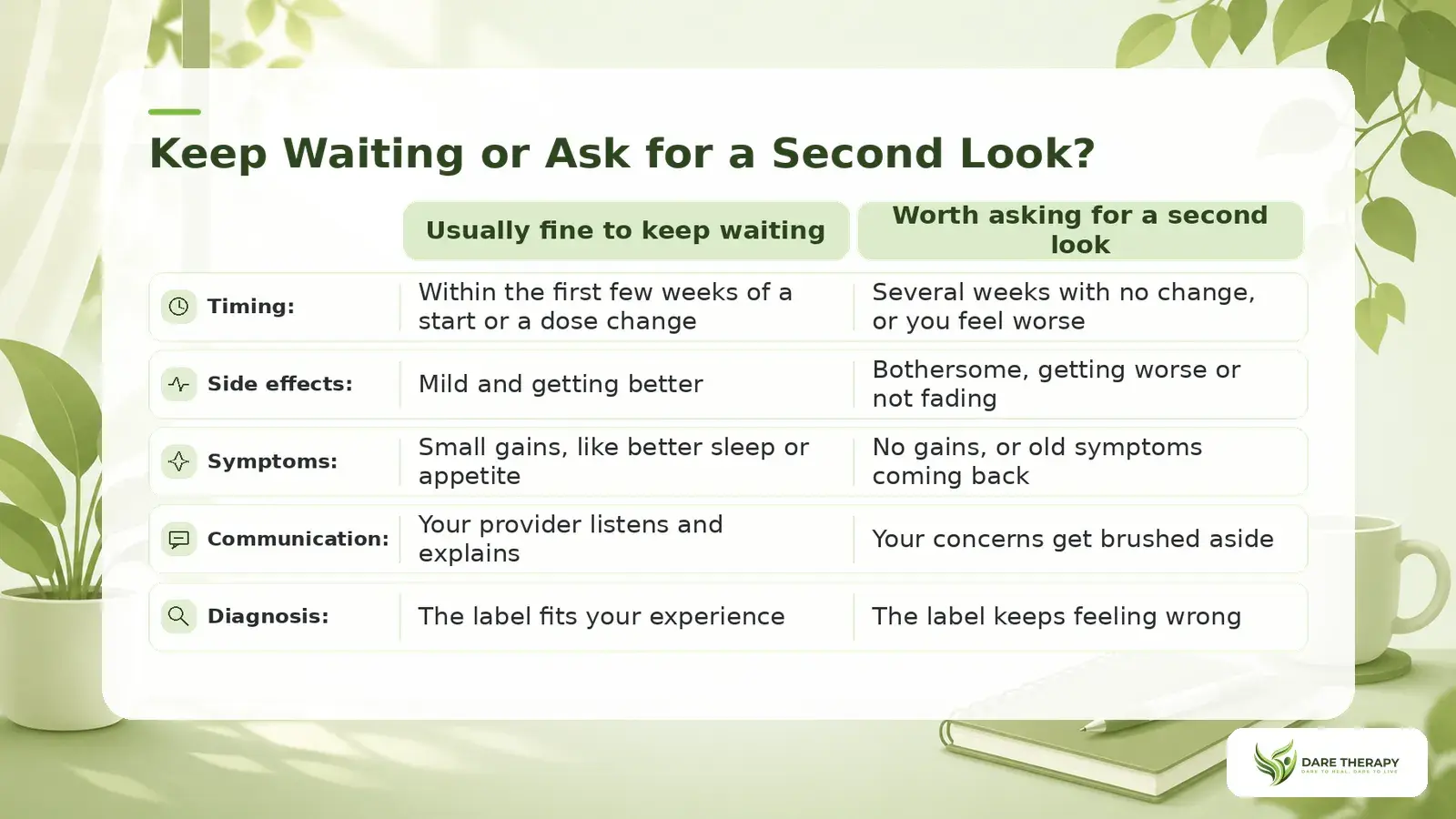
Does My Medicine Need More Time, or Is It Time for Another Opinion?
Here is a quick way to sort it out. This is a general guide, not a rule, and your own provider knows your case best.
| What you’re seeing | Usually fine to keep waiting | Worth asking for a second look |
|---|---|---|
| Timing | You’re within the first few weeks of starting or changing a dose | Several weeks have passed with no change at all, or you’re worse |
| Side effects | Mild, and getting better as days go by | Bothersome, getting worse or not fading |
| Symptoms | Small gains, like better sleep or appetite, even if mood hasn’t moved | No gains, or old symptoms returning after an earlier improvement |
| Communication | Your provider listens, explains and adjusts when you report problems | Your concerns get brushed aside or you can’t get answers |
| Diagnosis | The label fits your experience | The label keeps feeling wrong |
How Long Should You Wait Before Deciding a Medication Isn’t Working?
It depends on the medicine, so the honest answer is to ask your provider at the start: “When should I expect to feel a difference, and what should I do if I don’t?” Having that date in your head makes later decisions easier.
For antidepressants, the usual range is 4 to 8 weeks for the full effect. Other medicines act faster or slower. Some need to be taken every day for a few weeks before they reach full strength and don’t work well when taken only now and then.
If you’ve reached the window your provider gave you and see little change, call. The usual next step is to talk with your provider about changing the dose, trying a different medicine or adding another one. A second opinion is one way to widen that conversation.
What Should You Not Do While You Decide?
Don’t stop your medicine on your own, and don’t change the dose without talking to your provider first. This is the most important point in this post.
Stopping suddenly can cause unpleasant or even harmful effects. Symptoms may return, and withdrawal-like symptoms can show up. Your provider can lower a dose slowly and safely, and that is the right way to come off a medicine. Some medicines, like benzodiazepines, are usually tapered slowly for this reason.
Don’t stop just because you feel better, either. Feeling better often means the medicine is doing its job.
Two more rules:
- Keep taking your medicine as prescribed until a provider tells you to change it, even while you wait for the second appointment.
- Contact your provider right away if you’re having problems or worry the medicine is doing more harm than good. Don’t wait for the second opinion for that.
Some people under 25 may have more suicidal thoughts or behavior when they start an antidepressant or change the dose, so anyone taking one should be watched closely in the first few weeks. If you ever have thoughts of harming yourself, call or text 988 or go to the nearest emergency room.
How Do You Ask Your Current Provider for a Second Opinion?
Tell them. That is the first step, and it is usually the easiest one. You might say, “I’d like another provider to look at my medication plan. Can you recommend someone, or send my records?”
Asking for a second opinion isn’t unusual, and most clinicians are understanding and supportive about it. Your provider can often refer you or suggest a colleague.
If you feel dismissed, you can also ask that your concerns be added to your record so any provider you see next can read what has already been tried and what you said.
If your provider can’t or won’t refer you, you can still book with another provider on your own.
What Happens at a Second Opinion Visit?
The details vary by practice. Here is what a medication review and second opinion visit looks like at Dare Therapy.
The provider starts by going through your history: what you’ve been diagnosed with, which medicines you’ve tried, how each one went and what you’re taking now. They ask about your symptoms today and how they’ve changed. They also listen to your concerns about the current plan, because those concerns often point to the answer.
From there, the review looks at how well your current medicine is working for your symptoms, and whether you need a closer look at the diagnosis. If it fits, we talk about adjusting the plan, and we follow up to see how the change is going. Changes are made only when clinically appropriate. Sometimes the answer is “stay the course.” That is a real outcome too.
You can keep working with your existing therapist while you get prescribing support from us. Therapy and medication care can run side by side, and we can work together with your current therapist.
Our providers are board-certified psychiatric nurse practitioners and licensed therapists, and visits are secure and virtual. If you want to see how this fits with the rest of our psychiatric services, see our psychiatry and medication care page.
What Should You Bring to a Second Opinion Appointment?
Come prepared. A short, organized story saves time and gets you better answers.
- A full medicine list. Include everything: prescriptions, vitamins, supplements and anything you take now and then. Tell the provider about allergies and any past problems with medicines.
- Your history with each medicine. Write down roughly when you started, the doses, when they changed and how each one went. Dates don’t have to be perfect.
- Your records. Test results and notes from earlier providers are useful if you can get them.
- Your symptoms, in plain words. Be as specific as you can. “I wake at 3 a.m. and can’t fall back asleep” is better than “my sleep is bad.”
- Your questions. Write them down before the visit so you don’t forget them.
- The outcome you want. Think about what “better” looks like for you. More energy? Fewer panic episodes? Fewer side effects? Being clear helps the provider aim at it.
Be honest, including about missed doses. Providers can only work with what they know.
What Questions Should You Ask?
A few that tend to open things up:
- Does my diagnosis match what I’ve described?
- Is there anything else that could explain these symptoms?
- Do my medicines and doses make sense for this diagnosis?
- Which side effects should fade, and which ones mean we should change something?
- What are my other options, including different medicines or adding therapy?
- How long should I give any change before we judge it?
- What should I track between visits?
- How can I reach you if something changes?
If something doesn’t make sense, ask for it to be explained again. You are allowed to understand your own plan.
What Can Come Out of a Second Opinion?
Four outcomes are common, and none of them means the visit was wasted:
- The new provider agrees with the plan. That can be a relief. You can go forward with more confidence, and you may know what to watch for.
- They suggest adjustments. A dose change, a different medicine, an added medicine or a different schedule.
- They suggest more evaluation. If the diagnosis is unclear, further assessment may come first.
- They see the diagnosis differently. This is less common, but it happens, and it can change the whole plan.
There is a downside to know about, too. Two providers may give different advice, and that can feel confusing. If that happens, don’t pick one and ignore the other. Ask each to explain their reasoning, then ask them to share notes. A good prescriber is glad to talk it through. It can also take extra time to book and attend a second appointment, so if your symptoms are severe, don’t let waiting put you at risk. Contact your current provider or get urgent help.
Is a Second Opinion Different for Different Conditions?
The reasons are similar, but each condition has its own details.
Depression. Many people try more than one medicine before one fits. If you’ve been through a few without relief, ask about other options. Our post on depression treatment with therapy and medication explains how those choices usually work, and our depression care page lists what we offer.
Anxiety. Anxiety care often mixes medicine and therapy, and the right balance varies. If your medicine takes the edge off but you still feel stuck, that may be a sign to look at the whole plan. See how anxiety treatment works and our anxiety services. If you’re also unsure whether medicine is the right tool, this post on whether anxiety needs therapy may help.
ADHD. Some ADHD medicines can raise blood pressure and heart rate, so follow ups matter. If you’re still not sure the diagnosis is right, or the medicine isn’t doing enough, our adult ADHD evaluation and prescribing service can take a fresh look.
Bipolar disorder. Some medicines for mood conditions need regular blood tests and level checks, which makes steady follow up part of care. Our bipolar disorder care page explains our approach.
After having a baby. Medicine choices can look different during and after pregnancy, and questions about them are common. We offer postpartum medication management for this.
Should You See a Psychiatric Provider or a Therapist?
Prescribing is done by a medical provider, and therapy is done by a therapist. They do different jobs. If you’re not sure which one you need, this guide to psychiatrist or therapist explains the difference. If you’re choosing between types of therapy, how to choose therapy is a good start.
Many people use both, and a second opinion on medicine doesn’t need to disrupt therapy you already like.
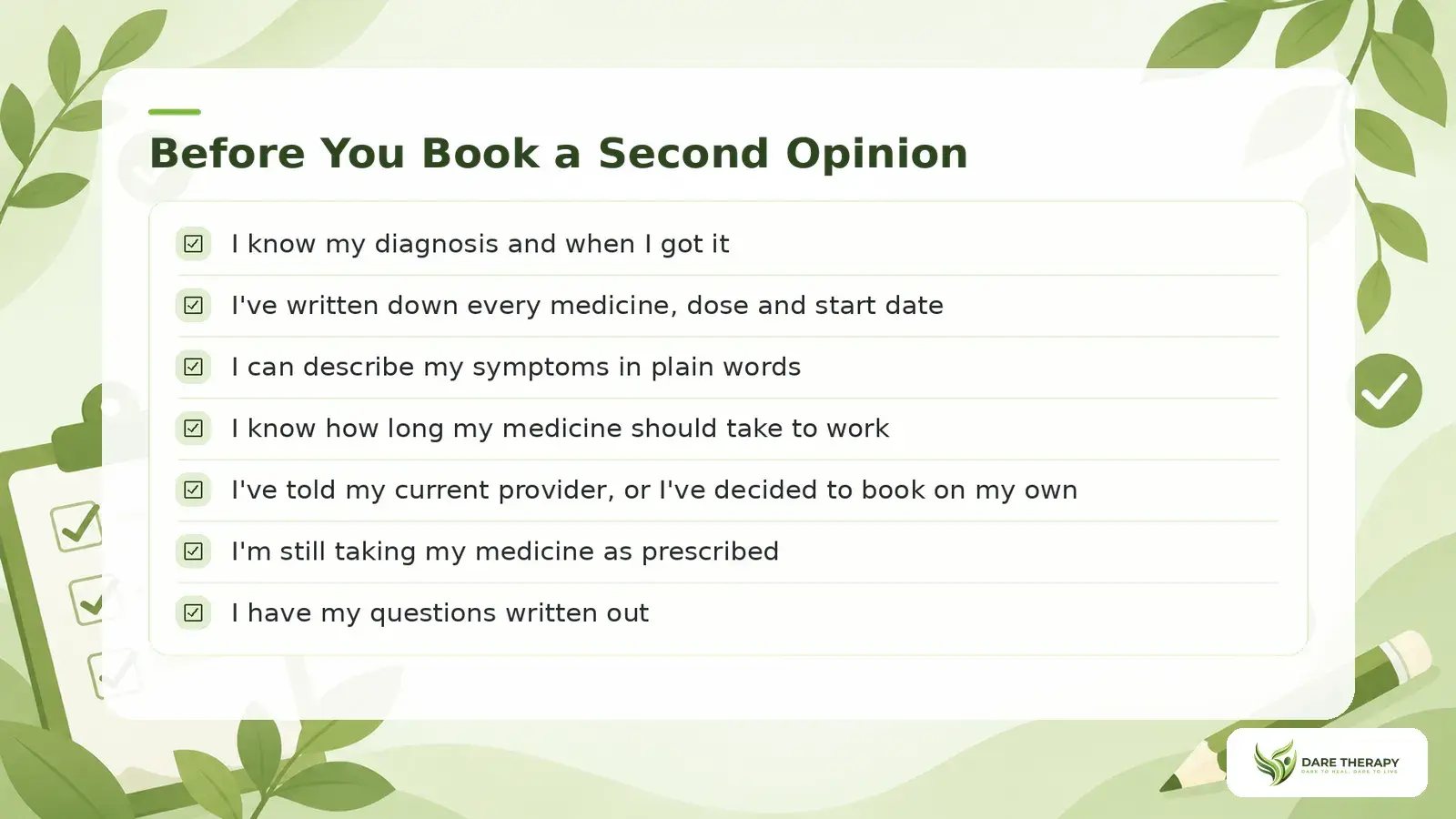
A Short Checklist Before You Book
- I know what my diagnosis is and when I got it.
- I’ve written down every medicine, dose and start date.
- I can describe my symptoms in plain words.
- I know how long my current medicine should take to work.
- I’ve told my current provider, or I’ve decided to book on my own.
- I’m still taking my medicine as prescribed.
- I have my questions written out.
If you can tick most of these, you’re ready.