

You’ve decided to get help, and now you’re stuck on the first step. Do you book a therapist, a psychiatrist, or both? The names sound close, the websites don’t explain the difference well, and nobody wants to pick the wrong door and lose weeks.
Here’s the short answer to the psychiatrist vs therapist question. See a therapist when you want to work through your thoughts, feelings, habits or relationships in talk therapy. See a psychiatric provider when you want a medical evaluation, a diagnosis, or a conversation about medication. Plenty of people end up needing both, and starting with one doesn’t lock you out of the other. The rest of this page breaks down who does what, who can prescribe, and how to tell where you should begin.
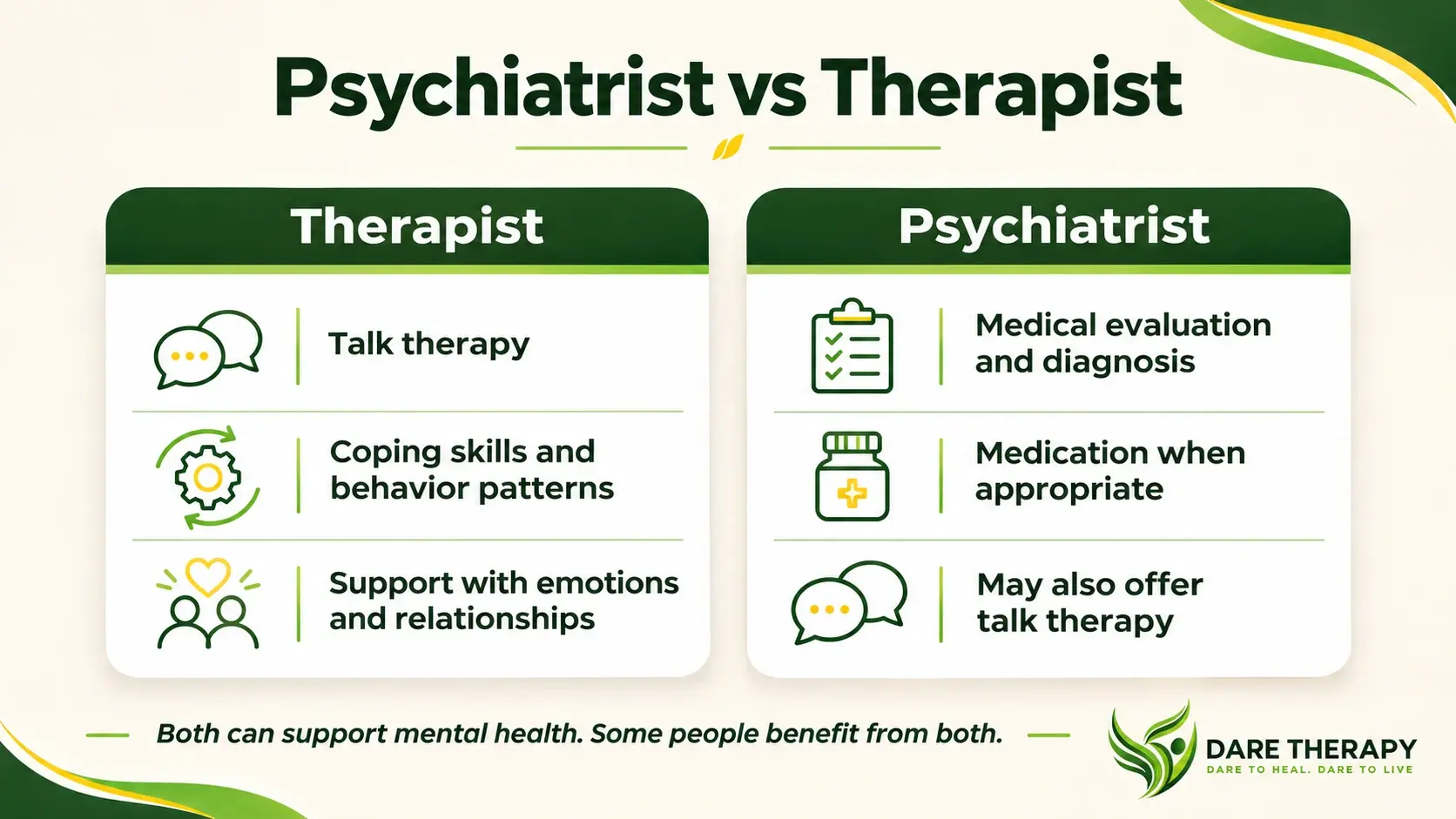
What is the difference between a psychiatrist and a therapist?
The biggest difference is the kind of care each one gives and what they’re licensed to do.
“Therapist” is a broad word. It covers psychologists, licensed counselors, licensed clinical social workers, marriage and family therapists and others who provide talk therapy. Talk therapy, also called psychotherapy, is a group of treatments that help you notice and change troubling emotions, thoughts and behaviors. Most sessions are one on one, though some are in a group.
A psychiatric provider diagnoses mental health conditions and treats them, including with medication. A psychiatrist is a medical doctor (an MD or DO) who specializes in mental health. A psychiatric nurse practitioner is a registered nurse with mental health training and at least a master’s degree. Both can evaluate and treat mental health conditions, and what a nurse practitioner can do depends on training, experience and state law.
| Type of provider | Can prescribe medication? | Main focus |
|---|---|---|
| Psychiatrist (MD or DO) | Yes | Diagnosis, medication, and sometimes talk therapy |
| Psychiatric nurse practitioner | Yes, where state law allows | Evaluation, diagnosis and medication, with services that vary by training |
| Psychologist | Most are not licensed to prescribe in the U.S. | Talk therapy, and sometimes psychological testing |
| Licensed clinical social worker | No | Assessment and counseling |
| Licensed professional counselor | No | Counseling for a range of concerns |
What does a therapist help with?
A lot more than most people expect. Talk therapy is used for anxiety disorders, including OCD, phobias and PTSD, and for mood disorders like depression and bipolar disorder. It also helps with everyday struggles like stress, relationship conflict, grief and trouble sleeping. Therapy can help with most mental health concerns, which is why it’s so often the first thing people try.
What you do in sessions depends on the approach. Cognitive behavioral therapy teaches you to question unhelpful thoughts and break self defeating patterns. Exposure therapy helps with anxiety by letting you face feared situations a little at a time. Other sessions build coping and problem solving skills, communication skills, or mindfulness and relaxation habits such as slow breathing. If you want to see how these methods work in practice, how therapy helps walks through it, and types of ADHD therapy for adults shows how the approach changes for a specific condition.
Sessions usually happen weekly or every other week and last about 45 minutes to an hour, in person or by video. Some people feel better within weeks, especially with a short term problem. Longer standing concerns can take a year or more. For a closer look at timing, how many therapy sessions you may need for anxiety goes into detail.
What does a psychiatric provider help with?
A psychiatric provider starts with an evaluation. They ask about your symptoms, how long they’ve lasted, your health history and any medications you already take. A psychiatrist is also a medical doctor, so they can look at both the mental and physical sides of a problem, including ordering lab tests when that’s useful.
From there, a diagnosis follows the standard criteria used across the country, and you talk through treatment options together. Medication is one of those options, not the only one. Psychiatrists often prescribe medication alongside psychotherapy, and many also offer talk therapy themselves.
If medication is part of your plan, the care doesn’t end at the first prescription. Follow up visits are how your provider checks whether it’s working and whether you’re having side effects, and they matter most in the first few weeks. Medication reviews are built around exactly that kind of check in, and online medication management covers the full process.
How do you know if you should start with a therapist?
A therapist is often the right first step when what you want is skills, space to talk, or support through something specific. These situations usually point that way:
- You’re dealing with stress, a breakup, grief, a move, a new job or another big change.
- Your thoughts spiral, and you’d like tools to handle them.
- Your relationships feel strained and you want help communicating.
- You’re not sure what’s wrong, but you know you don’t feel like yourself.
- You’d like to understand your patterns before deciding anything else.
If you aren’t sure whether what you’re feeling is “bad enough” for treatment, how to know when it’s more than just a bad day can help you sort it out. And if your worry has you wondering whether it will pass on its own, does anxiety need therapy or will it go away answers that directly.
How do you know if you should see a psychiatric provider?
A psychiatric provider is worth seeing when you want a medical view of what’s happening, or when medication might be part of the answer. People often seek this out when:
- A panic attack, or sudden and frightening symptoms, have shaken you.
- Sadness, hopelessness or anxiety just won’t lift, no matter what you try.
- Your symptoms get in the way of work, school, sleep or your relationships.
- You’ve tried therapy and it hasn’t been enough on its own.
- You already take medication and want it reviewed.
- You’d like an evaluation for ADHD, bipolar disorder or another condition.
Talk therapy on its own may not be enough to ease the symptoms of some mental health conditions, and that’s a common reason people add a psychiatric provider. If you want to see how different conditions come up in these visits, adult ADHD evaluations and prescribing and bipolar disorder care show what the evaluation covers. Mood changes after a baby also deserve their own kind of attention, and postpartum medication management is built for that.
Do you need both a psychiatrist and a therapist?
Many people do, and it isn’t a sign that something is “worse.” Medication is often used together with psychotherapy because each one does a different job. Medication can ease symptoms like low energy, poor sleep or constant worry. Therapy gives you the skills to cope, change habits and work through whatever is underneath.
For some people, talk therapy alone works well. For depression, it can sometimes work as well as antidepressants. For others, therapy alone isn’t enough and medication helps. You may also need more than one provider, because one person might handle your medication while another handles your sessions.
If you want to see how this plays out for specific conditions, anxiety treatment with therapy, medication or both and depression treatment with therapy, medication or both compare the options. When both anxiety and low mood are in the picture, depression and anxiety together explains why they so often show up as a pair.
Is therapy or medication faster?
They work on different timelines, and neither one is instant. Some people feel better within weeks of starting therapy for a short term problem. Longer term concerns can take a year or more.
Medication has its own wait. Antidepressants usually take 4 to 8 weeks to work, and sleep, appetite, energy and focus often improve before mood does. It can also take several tries to find the medication that works best with the fewest side effects, so a first choice that doesn’t fit is common and doesn’t mean treatment has failed. Your provider can adjust the plan as you go.
One firm rule applies here. Don’t stop a prescribed medication on your own. If you’re having problems with it, or you’re worried it’s doing more harm than good, contact your provider right away. They can lower the dose slowly and safely when that’s the right move.
Can your primary care doctor help first?
Your primary care provider can be a good starting point, especially if you’d like a referral or a recommendation for who to see.
You don’t have to go through a primary care doctor to see a therapist or a psychiatric provider, though. Plenty of people book directly. If you’d like to see how booking a mental health visit from home works, the benefits of online mental health therapy covers what that looks like.
What if you’re still not sure which one to pick?
Then pick the one that feels easier to book, because starting matters more than starting perfectly. Starting with one doesn’t lock you in, and providers can point you toward the other kind of care when it fits.
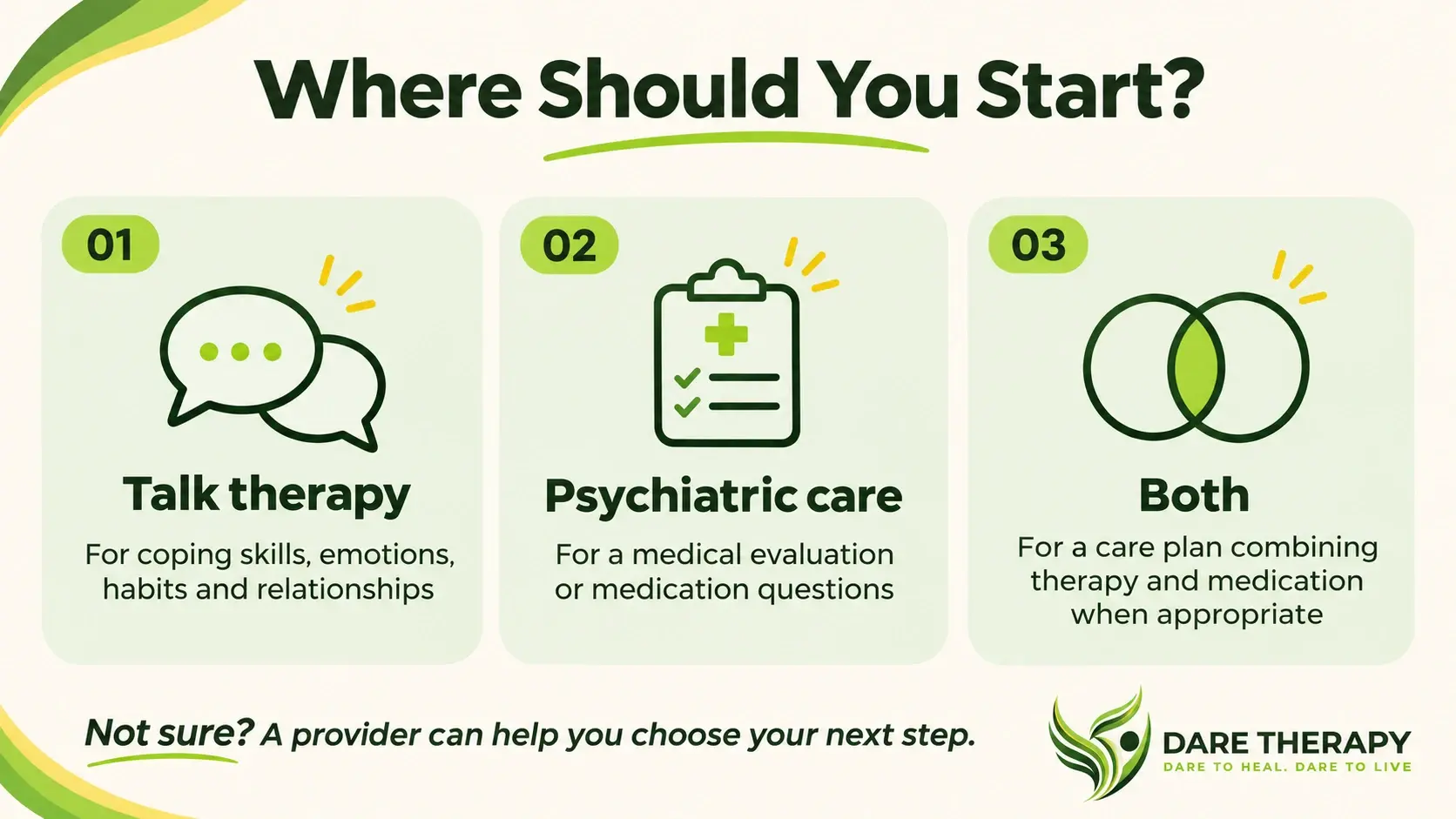
Here’s a quick way to decide. Ask yourself two questions. Do I want to understand and change how I think, feel or cope? That points to therapy. Do I want a medical evaluation, or to talk about medication? That points to a psychiatric provider. If you said yes to both, you’re likely looking at a combination.
When you’re choosing a provider, make sure they’re licensed to offer mental health services in your state. Think about whether you want counseling, medication or both, and whether the provider has experience with your concern. More complex or severe conditions generally call for more specialized training. For help comparing, how to choose therapy lays out the options step by step, and individual therapy is a good place to start if talk therapy is your first step.
Which conditions often need medication and therapy together?
There’s no single list that applies to everyone, but some conditions come up often in both kinds of care. These include anxiety and panic, depression, ADHD, bipolar disorder, trauma related symptoms and OCD.
If your main concern is anxiety, online anxiety therapy and the difference between anxiety and a panic attack are good places to start. For low mood, online depression therapy and depression warning signs you shouldn’t ignore cover both the feelings and the signs. If trauma is part of the story, online trauma and PTSD therapy and trauma and physical symptoms explain how it can show up. For attention and focus, online ADHD therapy is the place to look. And if you’re taking medication for more than one concern, anxiety and depression medication management covers how that care is handled.
When should you get help right away?
If you ever have thoughts of hurting yourself, call or text 988 at any hour. If someone may be in danger, call 911 and stay with them. These are the right calls even if you haven’t booked any other care yet.