

Yes. Trauma can show up in the body, and it often does. Headaches, stomach trouble, a racing heart, poor sleep, aches that move around and never quite explain themselves. Some people feel it in their bodies long before they connect any of it to what happened.
That doesn’t mean it’s imagined. The pain is real. The exhaustion is real. What it does mean is that your body and your mind aren’t two separate systems, and when one has been through something frightening, the other tends to hold on to it.
This post goes through what those physical symptoms can look like, why they happen, how they link to PTSD, and what actually helps. It’s general information, not a diagnosis, but if you’ve been wondering whether your body is trying to tell you something, it’s a fair question to ask.
Can trauma cause physical symptoms?
Trauma can affect the body. Of course it can.
The body goes on alert after a scary or dangerous event. For most that settles down in a few weeks. For others it does not. The body thinks the danger is still there and there is an increase in arousal; heart is racing, sweating, can’t sleep, jumpy, headaches, stomach aches.
Some of those are symptoms of PTSD. People can have emotional reactions to reminders of the event or they can have physical reactions. Some people can have physical reactions that are not as directly related to the event. Many people experience stress for a long time and it can cause issues for a person’s health.
It can affect people in many different ways and it can be expressed in many different ways.
Some of the ways that people can express it is by having headaches and having problems with the stomach. Children and adults can have tummy aches and headaches. Health services say that adults with PTSD have aches and pains with no reason as to why they are in pain, and children can have it as well. If a child is complaining of stomach aches and there is no reason as to why, it can be traumatic stress and something to look more into.
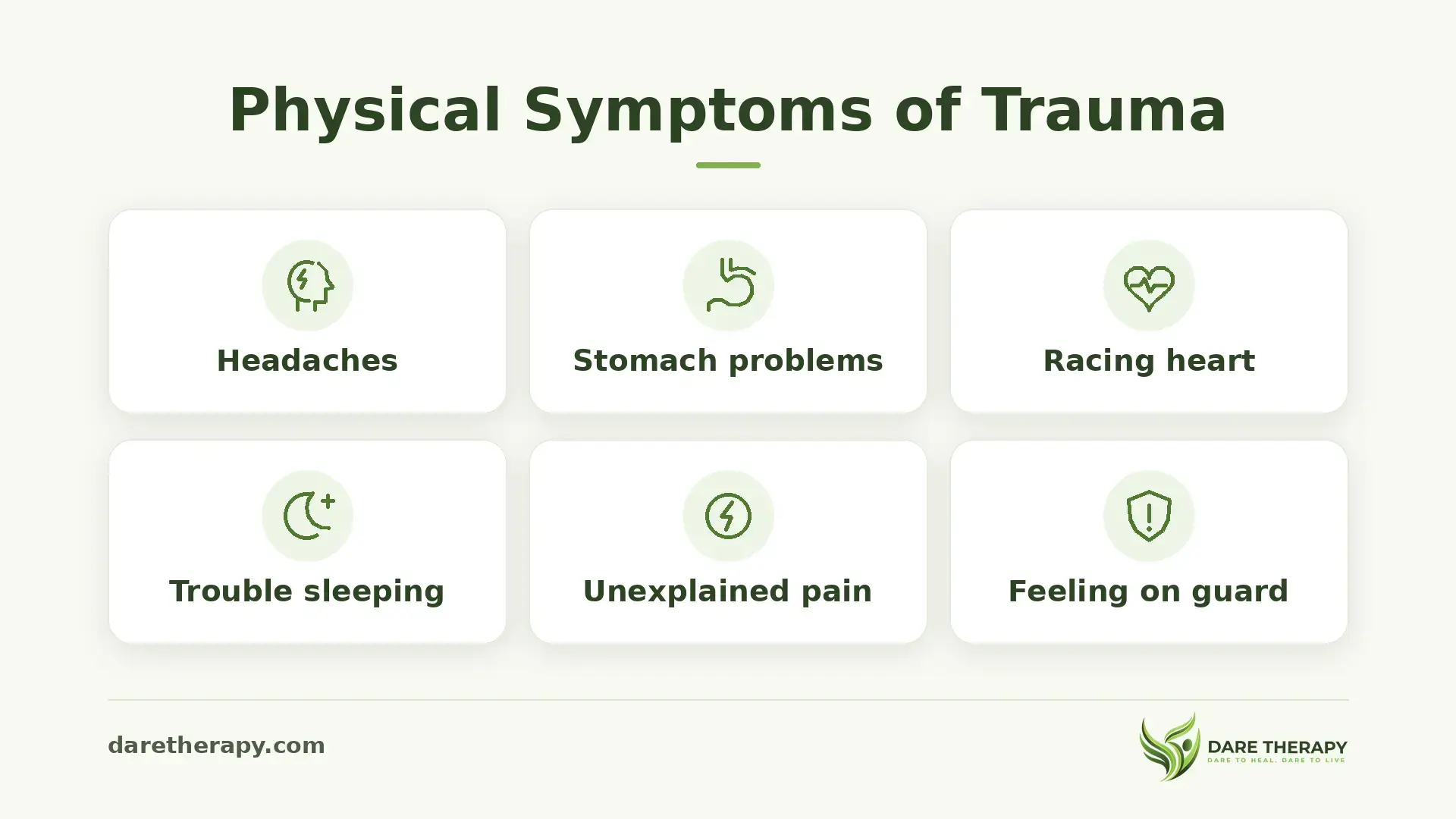
What physical symptoms can trauma cause?
The list is long, and it’s different for everyone.
Some of the most common are headaches and stomach problems. Health services describe adults with PTSD having repeated headaches, tummy trouble, or pain somewhere in the body that has no physical cause. Children can get tummy aches and headaches too. If a kid keeps complaining about their stomach and nobody can find a reason, that can be worth a conversation about what else is going on.
Then there’s the fight or flight side. A racing heart. Sweating. Being easily startled. Feeling constantly on guard, like you’re waiting for something to happen. Trembling, feeling sick, a tight chest. These can hit out of nowhere, or they can be set off by a sound, a smell, a place, a date on the calendar.
Sleep takes a hit, too. Trouble falling asleep, trouble staying asleep, nightmares. Bad sleep brings its own problems: tiredness, fuzzy thinking, a shorter fuse, more pain. We cover the nighttime side of this in why anxiety gets worse at night, and a lot of it applies here.
And for some people there’s chronic pain. Lower back, neck, jaw, head, pelvis. We’ll get to that in a minute.
Why does trauma show up in the body?
Honestly, nobody has a final answer. But here’s what’s understood.
PTSD is thought to come from a mix of things: how severe and how long the trauma was, family history, temperament, and how the brain handles stress chemicals and hormones. That last piece matters here. Those same chemicals and hormones run through the whole body, not just the brain. When the stress system gets stuck in the “on” position, it doesn’t stay politely in the mind.
Constant alertness is expensive. You’re tense. You’re not sleeping well. Your heart rate and breathing are running faster than they should. Your muscles are braced. Do that for weeks, or months, or years, and something’s going to give. Often it’s the back, the jaw, the head, the stomach.
There’s another piece. A body can react to a reminder of trauma before your thinking brain catches up. A smell, a sound, someone standing too close. Your heart’s already pounding before you’ve worked out why. People sometimes feel confused or even embarrassed by that, as if they’re overreacting. They’re not. It’s the alarm system doing a job it learned the hard way.
None of this means you’re broken. It means your body learned to protect you and hasn’t gotten the message that the danger is over.
Can trauma cause chronic pain?
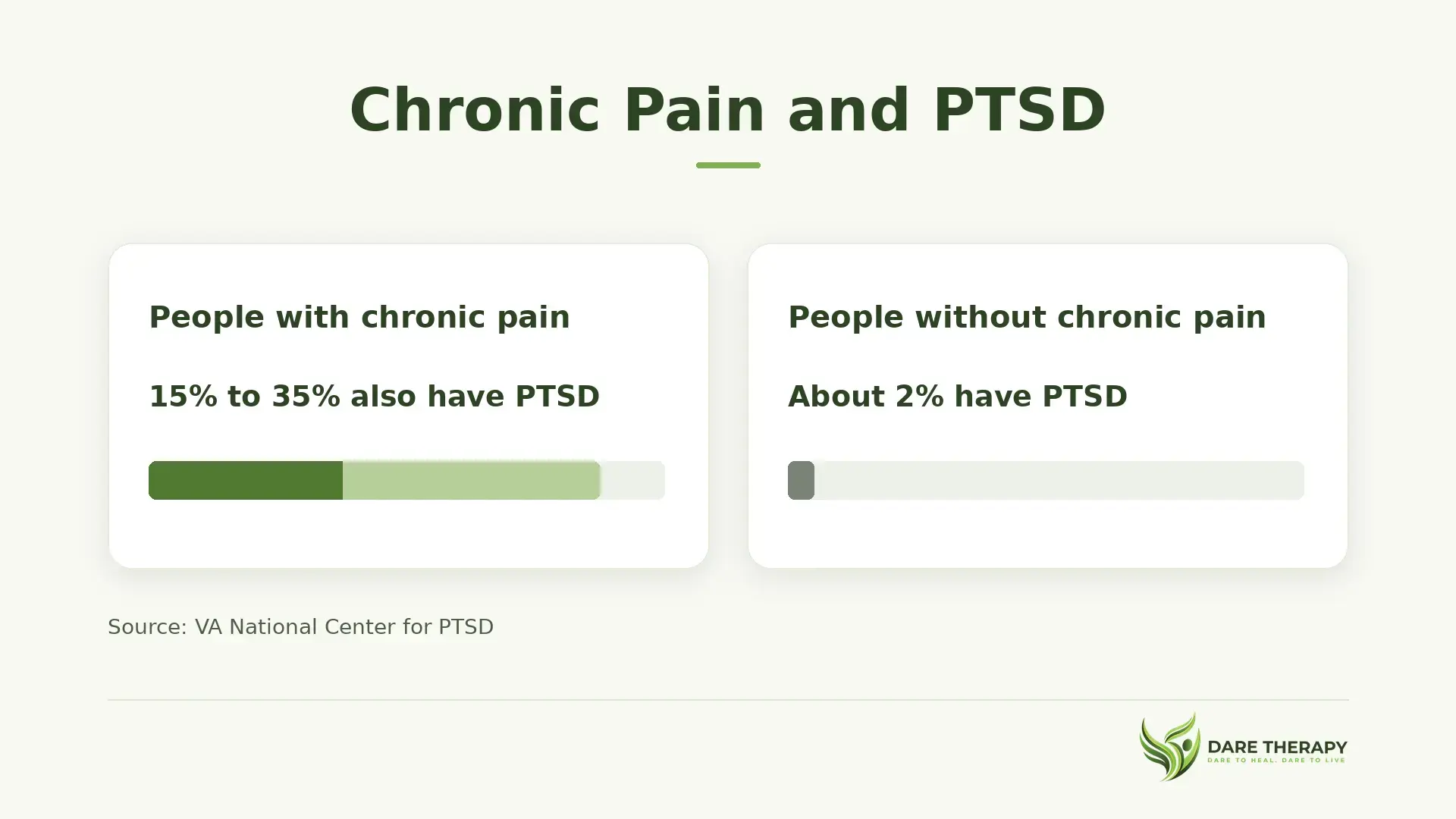
There is a clear connection between the two. People with PTSD and chronic pain occur together more than you would expect to happen by chance.
It is estimated that between 15% and 35% of individuals with chronic pain also have PTSD, in comparison to approximately 2% of people without chronic pain. That is a large difference.
Sometimes the pain is a direct result of a traumatic event, like an assault, a car accident or a natural disaster, and the person does not realize that the pain and the trauma are connected. Pain can be a daily reminder of a traumatic event and, therefore, can maintain the symptoms of PTSD. Pain and depression are closely connected and, often, helplessness with regards to pain can increase tension and pain, which maintains the cycle.
Individuals who have a history of physical or emotional abuse, or sexual abuse, have an increased risk for developing various kinds of chronic pain later in life. If you have a history of pain no one can fully explain, and you have a history of abuse, it would be worth your while to discuss this with a health care professional.
Can trauma make you tired all the time?
It can, though it’s usually indirect.
There isn’t a neat “trauma causes fatigue” switch. What happens is closer to a pile-up. Poor sleep. Nightmares. Being on guard all day, which burns energy even when you’re sitting still. Trouble concentrating. Low mood, or emotional numbness. Any one of those can wear you out. Together, they can leave you feeling flattened.
If you’re exhausted and you can’t figure out why, trauma isn’t the only possibility. Depression, anxiety, physical illness and plenty of other things can do the same. So get it looked at properly instead of guessing. Depression and anxiety together is useful if tiredness is mixed in with worry and low mood, and feeling numb instead of sad covers the flat, drained version of it.
Is this PTSD or a normal reaction after trauma?
After something frightening, upsetting memories, feeling on edge and trouble sleeping are common. Most people start to feel better after a few weeks. That’s the body and mind recovering, not a disorder.
PTSD becomes a possibility when those reactions hang on past about a month, feel very distressing, or start getting in the way of work, school or relationships.
To be diagnosed, an adult needs symptoms from four groups, for at least a month. First, reliving the event: flashbacks, nightmares, distress at reminders. Second, avoidance: steering clear of people, places or conversations that bring it back. Third, negative changes in thinking and mood: guilt, shame, numbness, losing interest in things, distrust. Fourth, being keyed up: easily startled, jumpy, irritable, poor sleep, trouble concentrating. And the symptoms can’t be explained by medication, substance use or another illness.
Only a mental health provider can diagnose PTSD. But you don’t need a diagnosis to ask for help. If something happened and your body hasn’t settled, that’s enough.
Can trauma symptoms show up years later?
Yes. And that catches plenty of people off guard.
Symptoms usually start within about three months of the event, but sometimes they don’t appear until years afterward. They can also come and go. A quiet stretch of a year or two, then something stressful happens (a loss, a new job, a baby, a reminder), and everything surfaces again.
That’s part of why physical symptoms get missed. If the headaches or the back pain started a long time after the event, nobody connects the dots. The person doesn’t either. Stress, trauma and PTSD explains more about how stress and trauma overlap and where they split.
And not all trauma is one big event. Repeated trauma, like childhood abuse or neglect, ongoing abuse at home, or repeatedly witnessing violence, can lead to something called complex PTSD. The symptoms are largely the same as PTSD, but the cause is different, and the road to recovery can look different too.
Do physical symptoms mean it’s all in your head?
No. Please don’t let anyone tell you that.
Pain with no clear physical cause is still pain. Stomach trouble that doesn’t show up on a test is still stomach trouble. When health services say symptoms have “no physical cause,” that means doctors couldn’t find a medical explanation, not that nothing is happening. The body is reacting to stress. That’s a real, physical process.
Still, it’s smart to see a doctor for physical symptoms. A headache could be a headache. Fatigue could be thyroid, anemia, a sleep disorder or something else treatable. Ruling out medical causes is a normal and helpful first step, and it doesn’t compete with getting support for trauma. You can do both at the same time.
When you see your doctor, mention what you’ve been through. Many people leave that out because it feels unrelated. It’s often the most useful thing a provider can hear.
How is trauma treated when it shows up in the body?
Mostly with therapy. For PTSD, talk therapy is the main treatment, and it’s the part with the strongest track record.
There are a few well-established approaches. Cognitive therapy helps you spot the thought patterns that keep you stuck, like blaming yourself or expecting the worst. Exposure therapy helps you approach memories and situations you’ve been avoiding, gradually and safely, so they lose their grip. Often the two are combined. Cognitive behavioral therapy is a common starting point. And EMDR, where you process trauma memories while focusing on eye movements or sounds, is another recommended option. EMDR for trauma and PTSD walks through how it works.
Therapy can be individual or in a group. Some people find a group helpful because it connects them with others who’ve been through something similar. Others do better one on one. Individual therapy for trauma recovery covers what that looks like.
Usually therapy for PTSD runs around 6 to 12 weeks, though it can take longer. Mood and other symptoms may start improving within a few weeks. Most people recover, though it can take a while and the path isn’t always a straight line.
What about the pain itself? If you have chronic pain, it often needs its own care alongside trauma treatment. That’s one reason to keep your medical provider in the loop. The two feed each other, so working on both tends to help more than working on one.
If you’re not sure which type of therapy fits, how to choose therapy helps you sort it out, and how does therapy help explains what to expect from the process in general.
Can medication help with the physical side of trauma?
Sometimes. It’s not for everyone, but it’s a real option.
Medication is usually used alongside therapy, not instead of it. Certain antidepressants can ease depression and anxiety and help with sleep and concentration, and several are approved for PTSD. Other medicines are sometimes used for severe anxiety, but those are generally prescribed for short periods because some can be misused. A few other options are still being studied, with mixed results.
A couple of practical things. It can take a few weeks to see changes. Finding the right fit sometimes means trying more than one, or adjusting the dose or timing. Tell your provider about any side effects. And don’t stop a medicine suddenly on your own, since that can cause its own problems.
Not everyone with trauma symptoms needs medication. But if sleep is wrecked, anxiety is through the roof, or low mood is making it hard to even do therapy, it can be worth a conversation. Dare offers online medication management for exactly that, so you can talk through the options with a provider and decide what fits.
What can you do about the physical symptoms in the meantime?
A few things can take the edge off while you get proper support. None of them replace treatment. They help your body feel a little safer.
Sleep first, because it affects everything else. Try to keep a regular bedtime and wake time. Limit caffeine and nicotine, since both can make anxiety and jumpiness worse. If you reach for alcohol or drugs to numb things out, be honest with yourself about it, because they tend to get in the way of recovery.
Move your body in ways that feel okay. A brisk walk. Stretching. Whatever you’ll actually do. Exercise and rest both matter, and so does eating regularly, even when your appetite’s off.
Stay in contact with people you trust. Isolation makes trauma symptoms heavier. A support group can help if talking to people who’ve been there feels easier than explaining yourself from scratch.
When anxiety spikes, a short walk or a hobby can help pull your attention somewhere else. And notice what triggers a reaction, without judging yourself for it. If you can say “that was a trigger,” it’s a bit easier to tell your body the danger’s over. Healthy ways to manage daily stress has more everyday tools, and overthinking and anxiety can help if your mind races at night.
When should you get help for trauma symptoms?
If upsetting thoughts or feelings about what happened have lasted more than a month, especially if they’re severe, that’s a good time. So is struggling to get your life back under control, or noticing physical symptoms that won’t go away and don’t have another explanation.
Getting help sooner tends to be better. Treatment can help keep symptoms from getting worse.
PTSD also raises the risk of depression, anxiety, drinking or drug problems, and thoughts of suicide. If you ever feel like you might hurt yourself, call or text 988 any time, or call 911. You don’t need to be certain about anything to reach out.
Disclaimer: This article is for general information only and isn’t medical advice or a diagnosis. Talk with a licensed provider about your own health. If you’re in crisis, call or text 988 or call 911.