

It can be. Bipolar II has low periods that look just like depression. What sets it apart is hypomania, a stretch of at least four days when your mood and energy run higher than usual. Hypomania often feels like a very good week, so many people never mention it. That is how bipolar II gets mistaken for depression. Only a trained clinician can tell the two apart, by looking at your full mood history and not only your low periods.
If you have been treated for depression and still feel stuck, this question is worth asking. This guide explains what bipolar II is, what hypomania looks like, which signs get missed, and what a careful evaluation checks. It is written to help you ask better questions, not to diagnose you.
What is bipolar II disorder?
Bipolar II disorder is a mood condition with two parts. You have had at least one major depressive episode, and at least one hypomanic episode. You have never had a full manic episode.
Bipolar II is its own diagnosis. It is not a “mild” version of bipolar I. The low periods can be deep and can last a long time, even though the high periods are less extreme than mania.
Here is the simple version:
| Depression only | Bipolar II | |
|---|---|---|
| Low periods | Yes | Yes |
| Hypomania (a clear high period) | No | At least one |
| Full mania | No | Never |
| Low period symptoms | Low mood, loss of interest, tiredness, sleep and appetite changes | The same symptoms |
The last row matters most. The low periods of bipolar II meet the same checklist as major depression. So if a clinician only looks at how you feel today, the two can look the same.
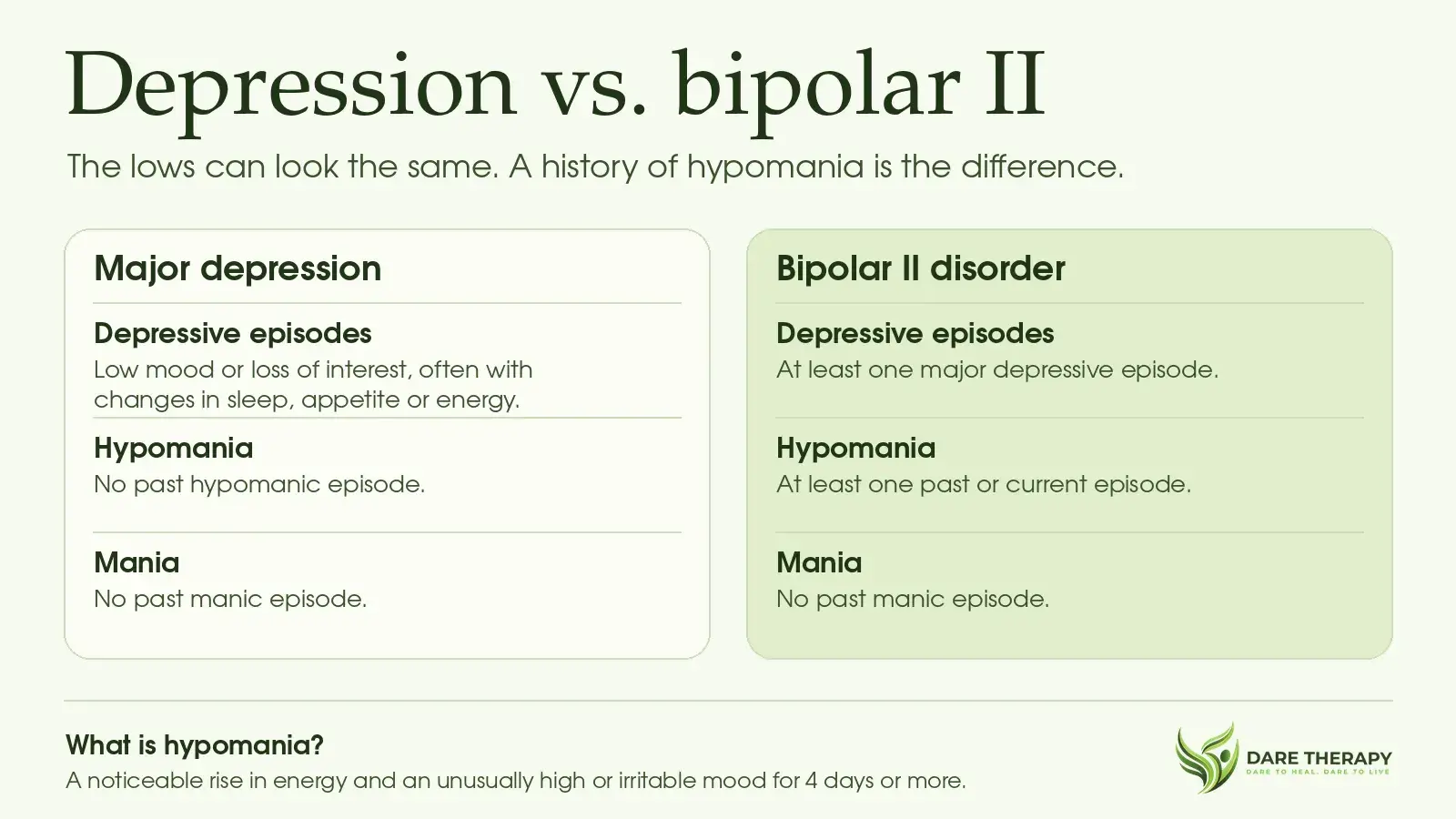
What is the difference between depression and bipolar II?
The main difference is hypomania. A person with depression only has low periods. A person with bipolar II has low periods and also has times when mood, energy, and activity rise well above their normal.
A major depressive episode needs five or more symptoms from a list. The list includes a low mood, loss of interest or pleasure, weight changes, sleep changes, feeling slowed down or restless, tiredness, guilt or worthlessness, trouble focusing or deciding, and thoughts of death or suicide. The episode must be strong enough to disrupt work, school, or social life.
Bipolar II uses that same list for its low periods. This is why the depressed phase of bipolar II cannot be told apart from depression by symptoms alone. The clue is somewhere else in your history: the high periods.
If you want a deeper look at how depression itself can show up, our guide to the different types of depression covers the main forms.
Why does bipolar II get mistaken for depression?
Bipolar II gets mistaken for depression for four main reasons.
- The low periods look the same. Doctors use the same symptom list for a depressive episode in both conditions, so the low phase gives no clear clue.
- Hypomania feels good. A few days of extra energy, less need for sleep, and sharp focus can feel like a gift. It can feel like “finally feeling like myself.” People rarely see a doctor when they feel this way.
- People do not remember or report it. When someone seeks help, they are usually in a low period. Many do not think to mention a good stretch from months ago, and some do not recall it at all.
- Depression is what brings people in. For people with bipolar II, depression is the main reason they ask for care, and depression takes up most of the illness over time. So that is the part clinicians see first.
The result is a long delay. Most people with bipolar disorder are not correctly diagnosed until about 6 to 10 years after they first talk to a healthcare provider about symptoms.
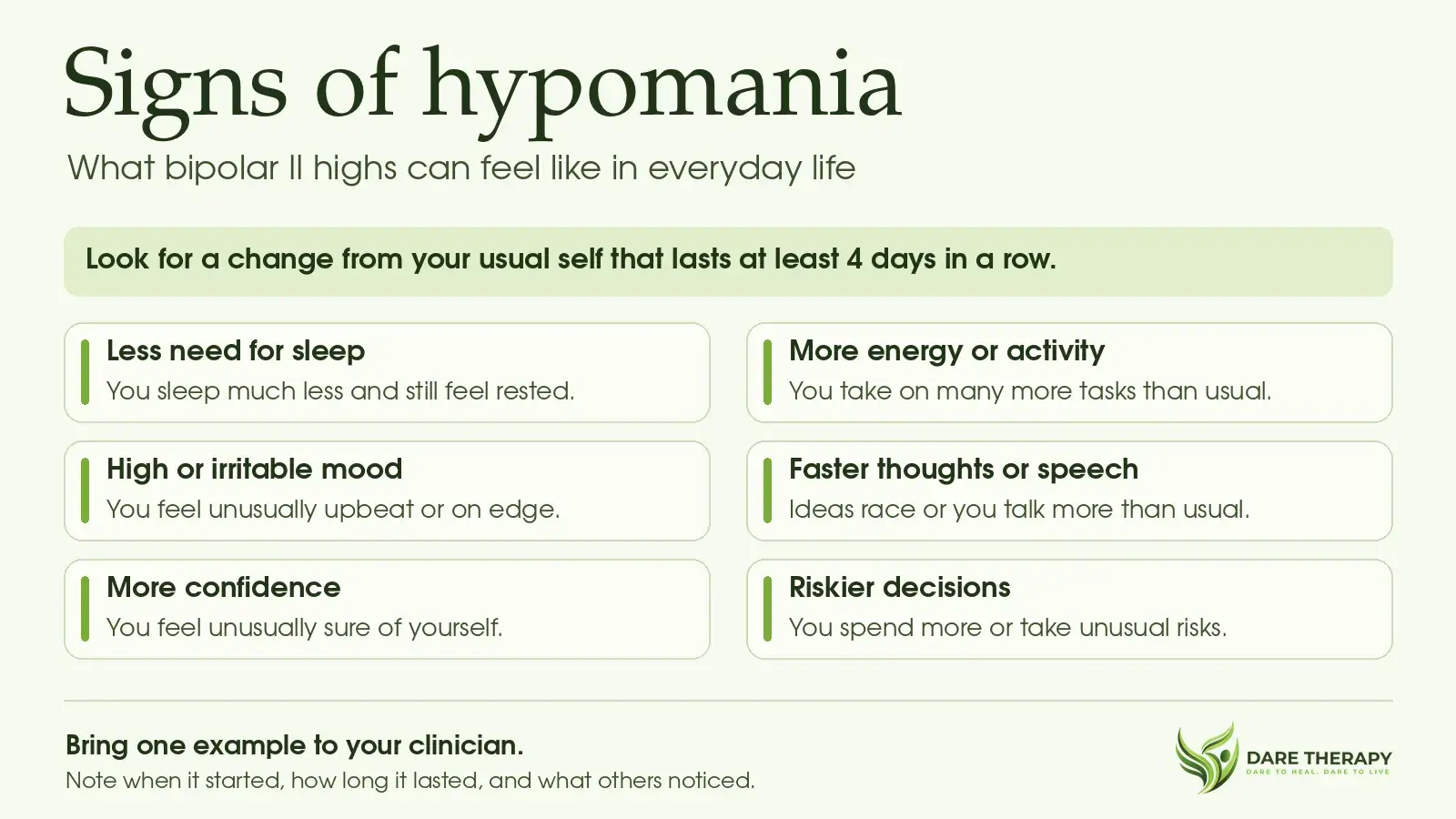
What is hypomania, and how does it feel?
Hypomania is a period of higher than usual mood, energy, and activity that lasts at least four days in a row. Symptoms are present most of the day, nearly every day. It is less severe than mania, but other people can see the change.
During hypomania, the mood is either high and upbeat or irritable. On top of that mood change, a person has three or more of these (four or more if the mood is mainly irritable):
- Feeling unusually confident or more important than usual
- Needing much less sleep and still feeling rested
- Talking more than normal or feeling pressure to keep talking
- Racing thoughts or jumping from idea to idea
- Being easily pulled off track by small things
- Taking on more goals, projects, or activities, or feeling restless
- Taking risks, such as overspending, risky business choices, or unsafe sex
Three things help separate hypomania from a regular good mood:
- It is a change from your normal. It does not match your usual self.
- Others notice it. Loved ones often see the shift before you do.
- It lasts. A single great afternoon is not hypomania. The change holds for days.
Hypomania does not cause major problems at work, school, or home, and it does not need a hospital stay. If there are hallucinations or delusions, or if the high lasts at least a week or needs hospital care, clinicians call it mania instead. Mania points to bipolar I, not bipolar II.
What signs can point to bipolar II and not depression alone?
No single sign proves bipolar II. But some patterns should make you and your clinician look closer. Here are the ones that get missed most often.
- A past stretch of high energy and little sleep. Think back over the years. Was there a time you slept only a few hours for several days and felt fine? Did you start many projects, talk fast, or spend more than usual? Did friends or family say you seemed “different” or “wired”?
- Irritability during a low period. Hypomanic and depressed symptoms can happen at the same time. This mixed state often shows up as irritability or anger while you feel low. Many people think of this as a short temper, not as a mood sign.
- Depression that started young. Clinicians ask about past highs more closely when the first depression began before age 25.
- Many episodes. Having five or more depressive episodes is another reason to ask about past hypomania.
- A family history of bipolar disorder. Having a parent or sibling with bipolar disorder is a known risk factor.
- A “wired” or “revved up” response to an antidepressant. If you felt unusually high, speedy, sleepless, or irritable after starting an antidepressant, tell your prescriber. A high or manic reaction to an antidepressant makes a bipolar diagnosis more likely.
- Treatment that does not hold. If treatments for depression helped for a short time and then stopped working, or never helped much, it is reasonable to ask whether the diagnosis is complete.
Some of these signs also fit other conditions. Trouble focusing, restlessness, and racing thoughts can show up in ADHD too. Our post on how to tell ADHD from bipolar disorder explains what is different, and why ADHD in women gets mistaken for anxiety, depression, or trauma shows how often one condition hides another.
Is there a quick checklist to see if my depression could be bipolar II?
You can use these questions as a starting point for a talk with a clinician. They are not a test, and answering yes to some does not mean you have bipolar II.
- Have you ever had four or more days in a row when your mood was much higher or more irritable than usual?
- During those days, did you need far less sleep and still feel full of energy?
- Did you talk more, think faster, or take on more than normal?
- Did people around you say you were not acting like yourself?
- Did you spend money, take risks, or make fast decisions you would not usually make?
- Did your first bout of depression start before age 25?
- Have you had five or more depressive episodes?
- Does a parent, brother, or sister have bipolar disorder?
- Did an antidepressant ever make you feel wired, agitated, or unusually high?
- Has treatment for depression helped only a little, or stopped helping?
Clinicians sometimes use a short screening form with questions like these, such as the Mood Disorder Questionnaire. A positive result does not give a diagnosis. It tells the clinician that a full assessment is a good idea.
Can antidepressants make bipolar II worse?
For some people, yes. Antidepressants are a normal and helpful tool for depression, but they are not always the right first step when bipolar disorder is present.
Here is what the clinical literature says:
- Antidepressants should not be used alone in most people with bipolar disorder. The risks include switching into mania or hypomania, and mood swings becoming less stable.
- Antidepressants can sometimes be used alongside a mood stabilizer or another medicine that steadies mood.
- In bipolar II, the picture is less clear than in bipolar I. Some studies show an antidepressant alone can work for bipolar II, and the chance of tipping into a high seems lower than in bipolar I. But the research is not settled, and for some people antidepressants may make the overall course worse or simply not work.
- If hypomania or mania appears while someone is taking an antidepressant, clinicians treat that as a sign the person may be on the bipolar spectrum.
Do not stop an antidepressant on your own because of what you read here. Stopping suddenly can cause its own problems. Tell your prescriber what you have noticed and ask for a review.
If you have been on the same medicine for a while without much relief, our guide on getting a second opinion on psychiatric medication explains when a fresh look makes sense. You can also read about depression treatment with therapy and medication.
How do clinicians check for bipolar II?
Bipolar II is diagnosed by a clinician, using your history. There is no blood test, brain scan, or other lab result that can diagnose it.
A careful assessment usually includes:
- A detailed interview. The clinician asks about your mood over your whole life, not only the last few weeks. This includes past high periods, sleep, energy, and risky or out of character behavior.
- Family history. Mood conditions often run in families.
- Past treatment. What you tried before, what helped, and what made you feel worse or “wired.”
- Input from people who know you. With your permission, a partner, parent, or close friend can often describe changes you did not notice. Loved ones often spot hypomania first.
- Screening forms. Short questionnaires can point to bipolar symptoms that need a closer look.
- A check for other causes. Some medical conditions, medicines, and substances can cause high or low moods. A clinician may ask about these and sometimes orders blood or urine tests, such as thyroid tests, to rule them out.
Dare Therapy’s bipolar care starts with a full psychiatric evaluation that covers mood history, sleep, energy, family history, and past treatment. You can read more on the bipolar disorder services page.
How can I prepare for an appointment about possible bipolar II?
Good notes make a big difference, because the most important facts are often the ones you have to remember. These steps help:
- Write a mood timeline. List your low periods and any high or “extra energy” periods you can recall. Rough dates are fine. Add how long each one lasted.
- Track sleep and energy. Note any stretch when you slept far less than usual and still felt fine.
- List past medicines and how you reacted. Include antidepressants, anything that helped, anything that made you feel agitated, wired, or flat, and anything you stopped.
- Write down your family history. Include any relative with bipolar disorder, depression, suicide, or substance use.
- Ask someone you trust. Ask a partner, parent, or close friend if they ever saw a time when you were not yourself in a high way. Ask them to be specific.
- Bring your questions. For example: “Could my depression be part of bipolar II?” and “Does my history point to hypomania?”
Our post on whether to see a psychiatrist or a therapist can help you decide where to start if you are not sure who to book.
How is bipolar II treated?
Bipolar II is treatable. Care usually combines medicine and therapy, and it is meant to be steady and long term, not short bursts.
Medicine. Medicines used for mood episodes include mood stabilizers and a group of medicines called second generation antipsychotics. Which one fits depends on your symptoms, your history, your health, and what you have tried before. A prescriber may sometimes add an antidepressant alongside a mood stabilizer. Care is often continuous, and not stopped and started, to help prevent new episodes. For bipolar II depression, treatment is generally similar to the treatment used for bipolar I depression.
Therapy. Cognitive behavioral therapy (CBT) can be added to medicine. It is used as a partner to medicine, not as the only treatment. Therapy can also help with early warning signs, daily routines, and sleep. Dare Therapy offers CBT and individual therapy, and therapists can work alongside your prescriber with your consent.
Daily habits. A steady sleep schedule, limiting caffeine and other stimulants, avoiding alcohol and drugs, regular movement, and calm routines all support mood. They support care. They do not replace it.
Follow up. Mood medicine often needs regular check ins. Some medicines also need blood tests to check levels. Regular visits let your prescriber adjust care as your needs change.
To see how medicine support works at Dare, visit the psychiatry and medication page and the medication reviews page.
What happens if bipolar II goes untreated?
Bipolar disorder does not get better on its own. Without the right care, depression tends to take up more and more of life. In people with bipolar II, depression makes up most of the illness, in both the early and later years. One long study that followed people for up to 20 years found that those with bipolar II had more depressive episodes and fewer well periods over time.
Depression in bipolar II also carries a real risk of suicide. That is why safety comes first whenever someone is in a deep low. If you have thoughts of ending your life, call or text 988 right away, or call 911 in an emergency.
Getting the right diagnosis early can save years of trial and error. It is also not a label that changes who you are. It is a clearer map of what your mind and body are doing, so the care you get matches it.
What if my low periods feel like depression but I also feel angry or on edge?
This is common in bipolar II, and it is one of the signs that gets overlooked. Some people with bipolar II have mixed states, where signs of a high and signs of a low happen together. It can look like feeling down while also feeling irritable, wound up, or full of racing thoughts.
It is easy to read this as “just stress” or “just my personality.” If anger, a short fuse, or feeling keyed up shows up alongside low mood, mention it to your clinician. It is useful information, and it can change which care makes sense.
Irritability can also appear in many other conditions, including anxiety, so it does not mean bipolar II by itself. Our guide to depression and anxiety together explains how overlapping conditions can be sorted out.
Does a bipolar II diagnosis mean my depression diagnosis was wrong?
Not always. Many people with bipolar II truly do have depressive episodes. The depression was real. What changes is the full picture. The low periods are one part of a mood condition that also has high periods.
A new diagnosis can feel like a lot. It may also feel like a relief, because it can explain why past treatment did not fit. Both reactions are normal. A good clinician will walk you through why they think the diagnosis fits, what it means, and what your options are.
If your symptoms feel like numbness more than sadness or emptiness even when life is going well, those are also signs worth a careful look, and they can have several different causes.
How can Dare Therapy help if I think my depression might be bipolar II?
Dare Therapy helps adults across Massachusetts with bipolar I, bipolar II, and related mood conditions by secure video. Here is how care works:
- A full psychiatric evaluation. Board certified psychiatric nurse practitioners review your mood history, sleep, energy, family history, and past treatment.
- Medication management. Prescribers can manage mood stabilizers and other bipolar medicine, with regular follow ups and lab work such as lithium blood levels when needed.
- Therapy alongside medicine. Licensed therapists can work with your prescriber, with your consent, on early warning signs, routines, and sleep.
- Care by video. Visits happen online, so you can attend from home. You can learn more about online medication management in Boston and telepsychiatry in Boston.
If low mood is your main concern, see our depression services and online depression therapy in Boston. You can meet the providers on the our team page, or contact us.
To get started, schedule your session online or call +1 857-737-8404.